

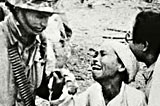
▶The Chinese Intervention
Unification of the Korean peninsula seemed all but inevitable as the combined Republic of Korea (ROK) and United Nations (UN) forces rapidly advanced past the 38th parallel and onward as far as the Yalu and Tumen Rivers. However, the subsequent intervention of China turned the tide of the war completely, and the combined forces were forced to make a strategic retreat.
China, having no role while the war was going to North Korea’s plan, started to show an interest in intervening as the combined UN forces started to advance towards the 38th parallel following the Gen. Douglas MacArthur-led UN amphibious landing at Incheon. Mao Zedong, upon receiving a formal request for assistance from the Soviet Union and North Korea, officially took China into the Korean War on October 19th, 1950, with a 300,000-strong army comprised of thirty divisions.
On New Year’s Eve, 1950, the Chinese People’s Volunteer Army (PVA) and Korean People’s Army (KPA) launched a combined offensive in the area around Munsan and Dongducheon, in what is now the area between Seoul and the North Korean border. The ROK Army’s 1st and 6th divisions tried in vain to hold the line in the face of the Chinese military’s human-wave tactics. On January 4th, 1951, the UN and ROK forces finally withdrew from Seoul on the orders of the then 8th U.S. Army Commander, Lieutenant General Matthew Ridgway.
▶The “January 4th Retreat” and the Armistice Agreement
Following the retreat, the combined forces dug in along the 37th parallel. With both sides locked in a stalemate, the armistice negotiations began while a series of battles for vital territory ensued. The ownership of Seoul switched hands multiple times before a deal was forged and the armistice signed on July 27th, 1953.
Today, the faces of those brave youths who fought valiantly in the war sixty years ago are covered with wrinkles. The weapons they held have been replaced with walking sticks. Everyman, too busy leading his own life, tends to forget their contributions all too easily. Past scars have become mere historical remnants in a thriving economy, with some even refusing to accept the risk of another war.
However, the war has not come to an end. An armistice means not the end of war, but a pause. Forgetting the past only serves to increase the chances of a tragedy revisited.
(Pictures provided by ‘The 60th Anniversary of the Korean War Commemoration Committee’)
[imText1]
[imText2]
[imText3]
[imText4]
[imText5]
[imText6]
[imText7]
[imText8]
[imText9]
[imText10]
[imText11]
[imText12]
[imText13]
[imText14]
[imText15]
[imText16]
[imText17]







