

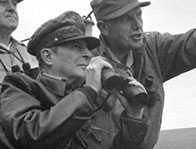
▶The Incheon landing
Having held the line at the Nakdong River down on the southeastern tip of the Korean Peninsula, South Korean and UN troops mounted their counteroffensive. The head of the United Nations Command, General Douglas MacArthur was seeking a way to turn the tide in favor of UN forces. He settled on an amphibious landing at Incheon, where troops could intercept the enemy lines of communication and crush the Korean People’s Army (KPA) forces in a single blow after joining with counteroffensive units.
UN troops launched the Incheon operation on September 15, 1950. The first hurdle was to retake Wolmi Island in Incheon Harbor. After three hours of heavy bombardment from UN forces, the island was retaken by 8 AM the same morning. The 1st Marine Regiment of the South Korean Marine Corps was charged with the remaining clean up operation. After the success of the landing at Incheon, South Korean and UN troops mounted a general counteroffensive, advancing toward Seoul.
▶ Hoisting the South Korean flag in victory
As the South Korean and UN troops began their attack on Seoul, the KPA sent two divisions to defend the city. However, these 20,000 soldiers were not enough to stop the advance, and KPA troops were driven out of Seoul. On September 27, the South Korean flag was again hoisted over the capitol building, and on the 29th there were festivities celebrating the retaking of the city. At the ceremony, General MacArthur turned over Seoul to President Syngman Rhee, and President Rhee in turn presented General MacArthur with an Order of Military Merit.
An estimated 4,000 men from South Korean and UN forces were lost in the amphibious landing at Incheon and subsequent attack on Seoul, whereas the KPA lost nearly 14,000 soldiers and 50 tanks. Seizing the chance of total victory, UN troops began a full-scale advance north on October 9th. The KPA retreated after suffering repeated losses, and the South Korean army pursued them as far as the Yalu River. At that moment unification seemed within their grasp. (Photographs from 60th Anniversary of the Korean War Commemoration Committee)







