

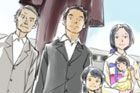
[imText1]“It is surprising that so few people outside of East Asia know about the existence of the hellish prison camps,” says CEO of Japanese media company Emotional Content Eiji Han Shimizu. “We hope that by using popular and accessible media such as anime, we can capture the attention of many, including the youth, who do not normally have exposure to topics related to North Korea beyond abduction cases and nuclear missiles.”
Shimizu is currently striving to obtain sufficient funding to complete a full-length animated feature about North Korea’s prison camp system, tentatively titled, “North,” an effort which he launched in April this year. He says his main aim is to “inform, inspire and empower others to generate positive actions in the world,” a fitting goal when talking about a topic as horrific, yet silent, as North Korea’s prison camps.
Like many people, Shimizu says he was inspired to join the fight for North Korean human rights after reading books about life in the prison camps; in his case “Aquariums of Pyongyang” by Kang Cheol Hwan and “Escape to the Outside World” by Shin Dong Hyuk; books “so powerful”, he says, that he decided to pursue the idea of making a film.
Shimizu also says that his mother, a Korean, used to tell him stories of family acquaintances who had made the fateful decision to return to North Korea in the 1960s, when Pyongyang was going to great lengths to advertise its “Heaven on Earth” to the Korean community in Japan.
”If I had been alive back then, I could have been the one who is going through hell today,” he muses.
Indeed it is that same decision to return which forms the backdrop to Shimizu’s planned film. “The main character’s family is one of the families who took the voyage to this ‘Heaven on Earth, to dedicate their lives and wealth for the construction of what was meant to be the greatest nation, and that would promote communist idealism,” he says. “Relatively peaceful days in Pyongyang enjoyed by the family abruptly end with the disappearance of the grandfather, and the main character’s forced transfer to Yudok concentration camp…”
Shimizu says that another part of the reason why he began his current project is because he sees limitations in current approaches to North Korean human rights advocacy.
“I noticed… that some activists and NGOs appeal to only a limited world audience,” he explains. “It is unfortunate that human rights abuses in North Korea are not well recognized in the world despite their magnitude. I wondered whether we should keep on using the same campaign tirelessly or rethink a new approach. My team has chosen the latter.”
“Using a popular and accessible media such as animation in this cause, we may be able to stir awareness and interest of the silent majority in the world,” he concludes, adding also that striking a blow against the camps can limit the effectiveness of the regime overall.
“We believe that the existence (or rumor) of such camps has been one of the key reasons why such an absurd system could retain its power for so many decades,” Shimzu also adds. “The fear of being sent to such places is such a threat to ordinary North Korean citizens that they are discouraged to take any action inside the country. We believe that helping to abolish these camps could both directly and indirectly reduce the total dominance of the regime.”
Unfortunately, the key to the viability of the project is funding. As Shimizu says, “We have great animators, episodes, connections, etc. except enough funding to make this project happen.” If funding can be found, a great boost to the North Korean human rights cause could be in the offing.
[imText3]
[imText2]







