

The recent replacement of the Minister of Unification appeared to place the emphasis on renewed flexibility in terms of North Korea policy. At the same time, the volume of voices urging a wholesale policy shift are growing in South Korean academic circles.
Supporters of a sunshine-style policy on North Korea have been strident in their accusations that the Lee administration bears a high degree of responsibility for the deterioration of inter-Korean relations, and that this has to change.
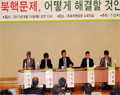
For example, speaking at a panel discussion yesterday entitled ‘What Would We Do for the North Korean Nuclear Issue?’, Koh Yu Hwan, a professor with Dongkuk University argued for exactly that, saying, “We can’t place the blame for the deterioration of inter-Korean relations and the suspention of the Six-Party Talks entirely upon North Korea.”
“The Lee government couldn’t prevent either systemic deterioration on the Korean Peninsula or the improvement of North Korea’s nuclear capability,” he went on. “They need to face the fact that the historical assessment of this government will be harsh, and that they have to conduct a root and branch review of North Korea policy.”
The Six-Party Talks have been in suspended animation since December, 2008. In the meantime, North Korea has launched a long-range missile and conducted a second nuclear test, not to mention unveiling a surprisingly advanced Uranium Enrichment Program (UEP).
For their part, South Korea and the U.S. continue to assert that certain moves to redress the situation are needed prior to any resumption of the Six-Party Talks; North Korea disagrees, a position that has the cautious backing of China and Russia.
Professor Koh also strongly criticized the South Korean government for maintaining the basic position, ‘apology for the Cheonan attack first, Six-Party Talks second,’ saying, “Despite U.N. sanctions and the May 24th Measures, North Korea hasn’t yielded and has held out by maintaining its relationship with China. The suggestion of a two-track policy dividing the Six-Party Talks and inter-Korean relations is gaining momentum.”
“We need to start a conversation with North Korea because the second half of this year is the last chance to prepare a turning point for inter-Korean relations and six-party talks,” he went on, noting that elections in the South will make fresh initiatives tough to enact in 2012.
In a similar vein, Yang Mu Jin, a professor with the University of North Korean Studies laid claim to a similar scenario in the newly released Sep/Oct edition of Korean Peninsula Focus, saying, “Although it’s late, in order to stop historical regression (a new cold war on the Korean Peninsula), the withdrawal of the Lee administration’s hard-line policy toward North Korea and a reconciliation and negotiation policy is a starting point.”
Yang characterizes the replacement of the Minister of Unification as an indication that the Lee administration is adjusting the direction of policy, from a principled policy to one of ‘following the rules but exercising flexibility reflecting current trends,’ though it is as yet unclear what that might mean.







