

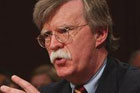
From John Bolton’s perspective, South Korea’s President Lee Myung Bak should carry to Washington today for his summit meeting with Barack Obama the intention to forge “an exit strategy from these failed negotiations” with North Korea; negotiations that are diverting attention and causing the world to take its eyes off the real aims as Bolton sees them.
The way to end the North Korean nuclear program is to end North Korea, he believes.
“Pushing North Korea through any of a variety of sanctions back to the Six-Party Talks in the hope that the Six-Party Talks will then resolve North Korea’s nuclear problem is a little bit like saying, ‘We’re gonna impose penalties on North Korea until they get back on that merry go round,’” the conservative former-U.S. Ambassador to the U.N. claimed at a forum organized by the American Enterprise Institute (AEI) last week.
In a further interview with Fox’s “On the Record” last Friday, Bolton suggested again that simply getting North Korea back to the negotiating table should not be the stated aim.
Instead, Bolton believes, “We really need to go to China and explain to them as forcefully as we can that their policy is… schizophrenic,” and ultimately unsustainable. The international community should be, in his words, “squeezing North Korea out of international financial markets,” to restrict regime funding until fundamental change occurs, not just the illusion of change brought about by North Korea returning to negotiations.
Reunification, he asserted with striking confidence, “is gonna come at some point or another, and China should get on the right side of history and help us manage it in the most humane, peaceful way possible.”
North Korea expert Nicholas Eberstadt agrees. Posting in Friday’s Wall Street Journal an abridged version of a speech he also gave to AEI, he strongly encouraged the two Presidents to, “Discard once and for all the illusion of so-called successful denuclearization of the DPRK through international dialogue,” since such a notion is “nothing more than a fantasy and a dangerous one at that”
He further encouraged the two to fill the void that such a decision would leave with the acceptance of a “threat-reduction paradigm” which could be characterized in North-East Asia by measures to constrain North Korean bellicose militarism; “more effective missile defense, an enhanced proliferation security initiative and a more muscular police effort against criminal sources of state revenue for Pyongyang.”
He completed his picture of the future by suggesting the need for explicit and detailed policy and contingency planning dialogues with allies to prepare for the end of North Korea, whenever it comes, and that Presidents Lee and Obama should be sure to “see the importance of a successful transition to a Korean peninsula that is democratic, economically free, and finally, at last, whole.”
“A grand historic objective,” he concluded, “a great prize.”







