

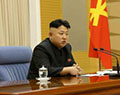
The first outcome of today’s inaugural session of the 13th
Supreme People’s Assembly (SPA) has seen Kim Jong Eun re-elected as 1st
Chairman of the National Defense Commission (NDC).
An extensive, congratulatory Chosun Central News Agency
release moments ago stated, “The session solemnly declared both at home and
abroad that Kim Jong Eun, 1st Secretary of the Workers’ Party of Korea and
Supreme Commander of the Chosun People’s Army, who leads the country and people
along the road to victory and prosperity, being possessed of rare ideological
and theoretical wisdom, distinguished political skill and noble virtue
attractive to all people, was elected 1st Chairman of the NDC of the DPRK,
reflecting the unanimous will and desire of all service personnel and people of
the country.”
Kim’s re-election is in line with the first acts of previous SPA sessions of a similar nature. During the opening session of the 12th
SPA in April 2009, for instance, Kim Jong Il was re-elected to an
almost identical position, Chairman of the NDC (which he continues to nominally
occupy despite having passed away in 2011).
The SPA consists of 687 delegates, one from each
constituency in the nation, and is constitutionally the highest branch of state power.
However, it only performs a symbolic role, confirming the decisions of the
Chosun Workers’ Party and orders of the leader on matters of national interest.
Even the delegates themselves are selected at the discretion of the Party. As such, there is widespread cynicism about events such as today’s session.
One former high-ranking defector compared the legislatures
of the two Koreas, telling Daily NK, “While the Supreme People’s Assembly is
similar to South Korea’s National Assembly in that it is structured as the most
powerful body in the land and is able to formulate laws, the reality is quite
different. In comparison to the South, where assembly members can freely
express their opinion, the delegates in North Korea can only repeat the Party
line like puppets.”
In addition, on surprisingly few occasions are policies agreed
upon by the SPA actually implemented on the ground. Thus, it would be hard to
find anyone inside North Korea who still has an interest in the machinations of
the legislature.
A second defector from South Pyongan Province pointed out,
“If a law or policy passes through the National Assembly in the South then
there is a quick response because it actually has an impact on people’s lives.
In North Korea, however, even if laws are passed by the Supreme People’s
Assembly there is no direct impact on people’s lives so they are not
interested.”
“The SPA
is used as a domestic and overseas propaganda tool. Hitherto, when there have
been decisions made that are apparently meant to improve lives through economic
development, there has been very little follow-through. So the people place no
hope at all in the process.”







