

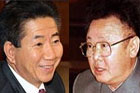
[imText1]With efforts of the preparation group with Unification Minister Lee Jae Jung for the second Inter-Korea Summit Talks, it seems like the North and South will have direct contact next week in Kaesung and tune the topics of the Summit Talks, the gathering interest.
Regarding this, Blue House spokesperson Chun Ho Sun expressed, “President Roh said to prepare and follow denuclearization for the peninsula, peace agreement issue for North and South, military regulation and economic cooperation to bring actual progress” showing that these four topics will be at the center of South Korea’s preparations.
Denuclearization of the Peninsula
After the nuclear tests of October, 2006, the North Korea nuclear weapons issues have been carried out hurriedly to create a roadmap to rid of North Korean nuclear weapons through the Six Party Talks and the February 13 Agreement. The February 13 Agreement that was quieted through the BDA (Banco Delta Asia) problem has been gaining more effect as North Korea stopped the operation of Yongbyun nuclear facilities on the 14th.
Currently, the working group meetings on secondary phrase of the February 13 Agreement to deactivate the nuclear are in progress and in early September, a Six Party Committee talk is planned. However, it is the analysis of experts that because we are at a level where all nuclear programs of North Korea must be reported and all nuclear facilities must be disabled, it will not be simple.
It is the opinions of those within and outside the government that it is meaningful to discuss the denuclearization of the peninsula at this time while the heads of the North and South gather. However, the problem isn’t that simple. In actuality, North Korea has the condition of the removal of the U.S. policy as an adversary state as priority for the giving up of nuclear weapons, the role of the U.S. is critical.
Such is the reason Assistant Secretary of State for East Asia and Pacific Affairs Christopher Hill visited North Korea in June and why the Six Party Talks are revolving around the U.S. and North Korea. Due to this, it is overly emphasized that “Denuclearization of the Peninsula is from the Instruction of Kim Il Sung” and an agreement working towards the denuclearization of the peninsula seems to be possible.
However, according to the principle of “action for action” to which the Six Party Talks is being carried out regularly, if a “gift package” is released by the South without discussing the giving up of nuclear weapons, the momentum of the Six Party Talks is sure to weaken. The U.S. is welcoming the Inter-Korea Summit Talks but such is why they are also concerned on the inside.
An exceptional progress may come if Kim Jong Il makes a bold decision, but as long as there is a basic concept that [North Korea] must speak with the U.S. on the nuclear issue, this will not be a simple part.
Peace Agreement
After the initial phrase to execute the February 13 Agreement, the South Korean government established and initiated a Task Force that included the Foreign Affairs Department of the Blue House, the Ministry of National Defense, the Ministry of Unification and the National Intelligence Service to create a roadmap for a peace regime and showed a proactive side regarding the peace agreement.
President Roh Moo Hyun emphasized last month in a conclusive meeting of the National Unification Advisory Council that, “The truce should be changed to a ‘peace’ and an economic era for the North should be opened through North-South cooperation”. Thus, it seems that in any way, the peace agreement discussions will be held at this Summit Talks.
Former Unification Minister Jung Dong Young appeared on a radio program on the 9th and predicted that “In the three-step process of Peace Declaration, Peace Agreement and Peace regime, I feel that it will be possible to reach up to the Peace Declaration.” However, it is unclear as to whether detailed discussion can progress as North Korea has the basic approach to discuss with the direct party of the truce agreement on the conclusion of any peace agreement.
With this, as the February 13 Agreement enumerates that “The directly related Parties will negotiate a permanent peace regime on the Korean Peninsula at an appropriate separate forum.” Therefore a “Peace Regime Forum for the Peninsula” can be initiated after the Summit Talks. Within this, it seems as there can be four participants – the North, South, the U.S. and China.
However, as the peace regime issue is tied with the nuclear weapons issue, criticisms arise that it is a lost cause to discuss the peace regime or a peace nuclear without giving up of nuclear weapons.
Military control
Regarding the issue of military control, as the North and South and large difference in opinion, it seems difficult to lead to a detailed agreement. Thus, there is a high possibility that South Korean government will require the responsible execution of the 1992 Inter-Korean Basic Agreement and the subsection of nonaggression that lists eight articles of trustworthy military actions.
Among the eight conditions, including the maritime nonaggression border issue that was required by the North includes ▲ no use of military power, ▲ prevention of unexpected military conflict and the peaceful solution of collision, ▲ the installment and operation of direct phone system for the military ▲ report of large scale military practice and movement drills as well as control ▲exchange of military personnel and information ▲ the peaceful use of the Demilitarized Zone ▲ phasedown of the reduction of armaments for removal of the ability for attack of WMD.
The North also may bring up the re-establishment issue of the Northern Limit Line (NLL) of the West Sea that is asserted every Summit Talks.
In the case of the National Defense Ministers Talks, the opening of a second meeting was approved during the first Talks in September 2000 but it has not been able to open for seven years. Regarding the general-level talks, a total of six meetings were opened since 2004 but due to the NLL problems and such there is no progress. Thus, for a more inclusive discussion, a Minters-Level Talks must be opened.
Along with this, it is possible to expect the establishment of a Joint Committee on North-South Military that is mentioned in the Inter-Korea Basic agreement. If a common base is established, the realization of a joint fishery zone, the problem of direct naval trips of North Korean civilian vessels, passage through the Kyungui Line (Seoul-Shinuiju) and the Donghae Line (Yangyang, Kangwon in the South – Ahnbyung, South Hamkyung in the North), extracting aggregates from the Han River sewers, preventing flood damage of the Imjin River in the North and problems of military guarantee for the economic cooperation business will be reached comparatively easily.
Economic cooperation
A portion of experts believe that North Korea agreed to this Summit Talks to use this as a connecting platform to a regularized relation with the U.S. In addition, as they had asserted an anti-Conservative coalition continuously to extend the Sunshine Power Administration in the South, it is the overall evaluation that they are trying to have effect in the South Korean presidential election.
However, what North Korea is most interested in is the remaining benefits through the Summit Talks. In 2000, considering that they took USD 500mn worth of ceremony fees for the 3 days, they must be interested in the gifts that South Korea brings.
Of course as the Roh Moo Hyun administration had had a special investigation to find and arrest related individuals, there is a low possibility that he will naively bring cash. Thus, under the name of North-South economic cooperation, Social Overhead Capital (SOC) investments would be the center for such activity.
The Ministry of Unification organized the requested business of the North last February for economic cooperation as “Economic Cooperation Business that North Korea Wants and Needs”. On this note, the North implies that it wants a total of 16 businesses in three sectors with four in the energy sector five in SOC and seven in miscellaneous.
Especially with the transfer of 2mn kW of electricity (USD 900mn a year), aid of anthracite equipment, business to open facilities in South Seaport, opening and construction a Pyongyang – Kaesung highway (307.billion won which is USD 334.5mn) that’s 170km and operation of a 330,000 ton fertilizer factory (350 billion won which is approximately USD 381mn) and establishment a tree nursery for areas such as Pyongyang, Kaesung, Hamheung and others is being considered so it is expected in the next several years that an estimated aid cost to North Korea will be USD 9.8 billion – 14.1 billion.
Aside from this problem of a regularly operated Kyungui Line and Donghae Line to actively promote the Kaesung Industrial Complex, North Korea underground joint-development forces, agricultural forces could be discussed.








