

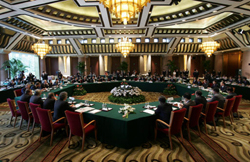
[imText1]The Chinese Foreign Ministry announced on the 11th “The parties concerned decided through consultation that the second session of the fifth round of six-party talks will start in Beijing on December 18.” It has been 1 year and 1 month since the six-party talks was stopped.
The most important issue of the six-party talks is the proposal by the U.S. for North Korea to take measures forfeiting its nuclear program and whether or not North Korea’s actions will meet this equilibrium.
The measures proposed by the U.S. last month 28~29th calls for the North to ▲ freeze the 5MW nuclear atom in Yongbyon ▲ approve inspection by the International Atomic Energy Agency (IAEA) ▲ honestly report all nuclear armaments an materials associated with nuclear programs and ▲ demolish all nuclear experiment facilities.
The U.S. has candidly stated that if North Korea agreed to the 4 actions above, it would take measures in providing energy, economic aid and normalization of the U.S.-North Korea relationship in accordance with the 9.19 Mutual Agreement,
On the other hand, North Korea’s initial measures have not been explicitly stated, but rather “U.S. corresponding measures” have first been requested. Considering the claims made by North Korea in the past, there is a high possibility that the removal of BDA financial sanctions will be solicited.
However, at the U.S., China, North Korea negotiations in Beijing, November 28~29th, North Korea’s attitude was “we’ll talk at the official talks.” Hence chances of a bilateral equilibrium between the U.S. and North Korea are rather low.
At the reconvention of the six-party talks, it is likely that the first thing the U.S. will earnestly seek is confirmation of North Korea’s will to sacrifice its nukes. Moreover, of the “freeze-report-inspect-destroy” actions, it appears that North Korea will be requested to follow the 2nd step of reporting information on its nuclear program. In response to the “corresponding measures” requested by North Korea, it is possible that deliberations will be made to actually demolish the nukes.
As a result, it is likely that the talks to reconvene on the 18th will end as a “talking offense” where each country simply declares its position. Here, it seems that a more firm stance of each country will emerge.
For this reason, there is much interest on whether or not an equilibrium will be found with China as an arbitrator to fulfill the 2 proposals, to end North Korea’s nuclear facilities and approve inspection by the IAEA, the proposition of U.S. financial sanctions, normalization of North Korea-Japan, North Korea-U.S. relations as well as economic and energy supply.
Nevertheless, if North Korea seeks removal of BDA financial sanctions and nuclear disarmaments from the beginning, we can expect the talks to be a futile verbal argument. If North Korea concentrates on seeking the prior settlements, the future of the talks may become more complicated.
Accordingly, great focus remains on each country’s preliminary negotiations on the weekend 16~17th prior to the reconvening of talks. Undoubtedly, it will be difficult to set an immediate agreement at the negotiations, however it will an outline of what the North is focusing on.







