
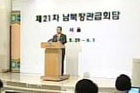
The third day of the 21st Inter-Korea Cabinet Talks may see North Korea making a proposal regarding the “400,000tons of rice” to South Korea.
From 2.30PM on the 30th, the North’s chief delegate spent about 30 minutes requesting South Korea to “deliver on its promises on the rice loan.” The overall analysis is that North Korea was reconnoitering the scene before it made any concrete requests.
Public information officer for the Unification Ministry Kim Nam Shik said, “The keynote address that was made by both parties had underlying comments to dwell upon” and revealed, “Nothing has been agreed as yet. Rather we must discuss these matters through the executive meetings.”
However, at the official dinner held on the evening of 30th at Walker Hill Hotel, there are signs to suggest that Unification Minister Lee Jae Jung and North Korea’s Cabinet Secretary Kwon Ho Woong may have had a clash over the issue of the rice loan to be discussed on the 31st.
At this gathering, Secretary Kwon said slurring his sentence, “The visit was pleasant, the meals and even until today, everything was good… but,” then, Minister Lee responded holding Kwon’s hands, “It doesn’t end today. Just as today was good, tomorrow will be good…”
“It would be perfect if the day after tomorrow is good and good for forevermore…” Minister Kwon said reverberating his words. Meanwhile from within the talks, others proposed, “For two days North Korea has been eyeing South Korea’s maneuvers and has not yet officially sought the issue of rice. This may be a planned strategy to propose the rice loan issue at the end of the talks.”
At the 13th Inter-Korean Economic Cooperation Promotion Committee in April, the South Korean government agreed to loan North Korea food aid and send the first lot of rice by the end of May. However, as North Korea’s implementation of the February 13 Agreement was delayed, the rice loan became linked to the matter which resulted in reserving the rice loan.
If North Korea strongly requests for the rice loan, it seems that the South Korean government will use a defense in convincing North Korea that the settlement made would go ahead as normal and that the rice was merely delayed. As Minister Lee asserts, its not that the rice “will not be given, not cannot be given,” its merely that the situation is being postponed.
If the rice issue is resolved smoothly, the South Korean government plans to dive into the Inter-Korea joint meeting of national policy research institutions, the Ministers’ meeting between South’s and North’s National Defense Ministry and economic cooperative negotiation which were proposed at the 1st General Meeting by the South.
The most critical argument the South Korean government has opted to take is a “peace” and “one national economy.” While South Korea strives for a “peace” and North Korea “economic cooperation,” it seems that the South Korean government is trying kill two birds with one stone.
Further as the normalization of U.S.-North Korea relations and Japan-North Korea relations working groups of the six party talks continues to make progress, some calculate that the working groups revolving the two Korea’s will also heed to this pace.
Since North Korea’s speech at the June 15th Summit Talks in 2000, the two countries have been making steady progress. Additionally, North Korea stated that foreign pressures had to be eliminated from the issue of one nation and that the remaining remnants of the Cold War also had to be removed.
North Korea raised the question on the “Reception Staging Onward Movement and Integration” and “abrogation of National Safety Law,” which have been mentioned since the 17th Inter-Korea Talks in 2005. However, at this current stage, many argue that rather than anticipating any immediate measures, continuous efforts and talks would be more profitable.