
I analyzed high-resolution satellite imagery of Paekam county, in North Korea’s Ryanggang province, and found that a hydroelectric dam has flooded part of a major North Korea railway line. North Korea responded by building a rerouted track and relocating two train stations to higher ground, according to imagery reviewed in 2026.
The images show that the Mount Paektu Hero Youth Dam No. 1 created Lake Sodusu, an artificial reservoir spanning roughly 800 hectares. That is about 2.8 times the size of Yeouido, an island in Seoul often used as a size reference in South Korea. The rising water submerged a 15 kilometer stretch of the Paekmu Line. This narrow gauge railway connects Paekam Cheongnyon Station in Ryanggang province to Musan Station in North Hamgyong province and is used mainly to move iron ore and timber. Two stations along that stretch, Samsa and Sangdan, were also submerged and closed.
To keep trains running, North Korea built a new bypass line. The route climbs along steep mountain slopes and higher ground west of the flooded valley, avoiding the water below. Samsa Station was relocated about 2.7 kilometers to the west. Sangdan Station was moved only about 200 meters up a nearby slope, reflecting the different terrain each site required.
North Korea has poured significant cost and labor into rebuilding rail access through this flooded mountain region. Its logistics system depends heavily on trains. Poor road conditions and an underdeveloped trucking network mean the country relies on rail to move heavy, bulky goods such as coal, ore and cement over long distances. Rail is estimated to carry about 90% of North Korea’s freight.
That heavy reliance does not mean the rail network is in good condition. Aging tracks and frequent power outages often keep trains from running at full speed. Some sections reportedly move no faster than South Korea’s old slow trains once did. Still, North Korea chose to cut through mountainous terrain to restore this route. Losing the line would disrupt not just train service but the country’s broader supply chain.
Dam floods North Korea railway line, forces reroute
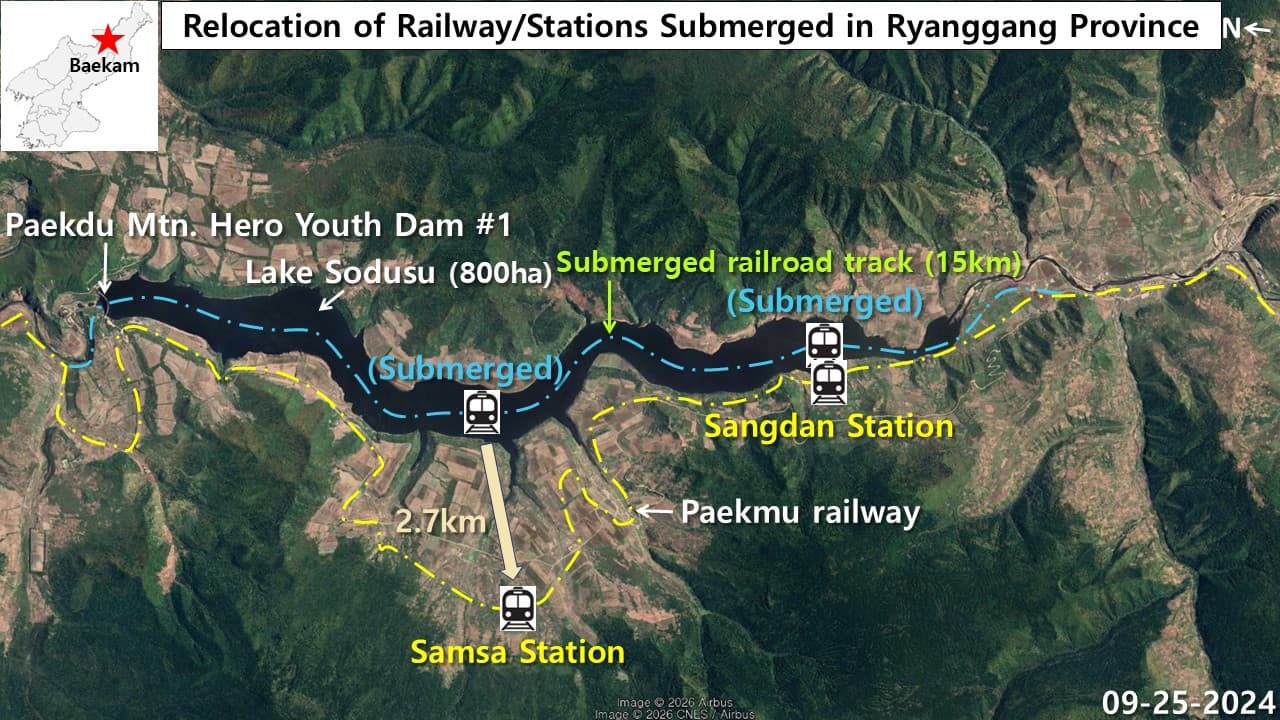
North Korea’s Mount Paektu Hero Youth Dam No. 1 was built along the Sodusu River in Paekam county, Ryanggang province. The project has reshaped the surrounding terrain. Engineers began filling the reservoir in late 2015. What was once a deep valley became a long, wide body of water now known as Lake Sodusu, tied to the No. 1 reservoir of the Mount Paektu Hero Youth Power Station. Satellite images show the reservoir, rendered as a dark expanse, covering roughly 800 hectares. That is more than 2.8 times the size of Yeouido, which spans about 290 hectares.
The valley once carried the Paekmu Line, one of North Korea’s principal rail links between Paekam Cheongnyon Station in Ryanggang province and Musan Station in North Hamgyong province. As the reservoir filled, roughly 15 kilometers of the original low lying track were submerged and shut down. A light blue dotted line in the satellite imagery marks the vanished route. Sangdan and Samsa, two rural stations along that stretch, were also submerged.
With the original line cut off, North Korea had to build a new route to keep trains running. A yellow dotted line in the satellite imagery traces the rerouted track. It climbs to higher, drier ground on the western side of the valley and winds along steep mountain slopes to avoid the water. Sangdan and Samsa stations were rebuilt on nearby high ground outside the flooded area.
Relocated stations rebuilt to identical design
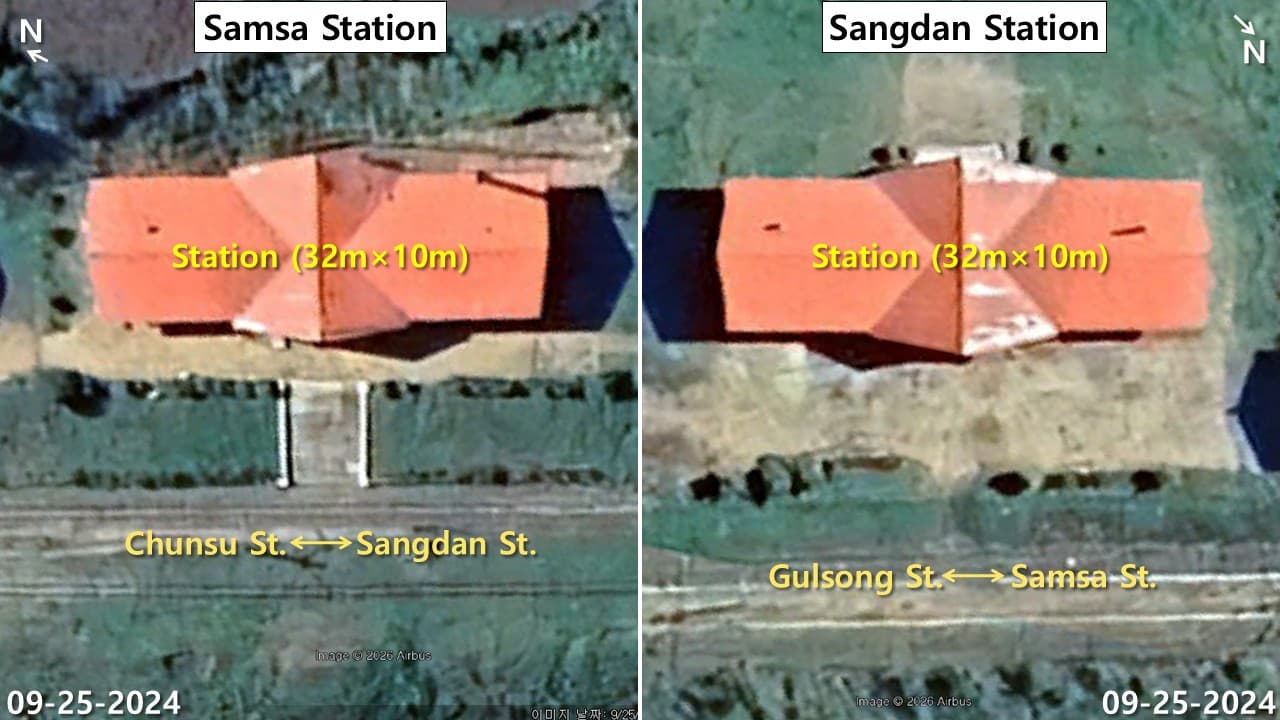
The relocated Samsa and Sangdan stations both sit on higher ground outside the flooded zone. In satellite imagery, they appear nearly identical. Each station building forms a rectangular structure measuring about 32 meters by 10 meters. Each has a slightly protruding, symmetrical section at the front facing the tracks, suggesting both were built from the same standardized design.
The two stations were relocated by different distances depending on local terrain. Samsa Station moved about 2.7 kilometers west of its former site. Planners likely needed to find stable ground well clear of the expanded reservoir. Sangdan Station, by contrast, moved only about 200 meters. A steep slope close to its original location offered high enough ground to avoid the floodwaters with a shorter detour.
North Korea’s rail dependent logistics system
North Korea’s logistics system runs on rail first and roads second, the reverse of South Korea’s truck centered model. Rail is estimated to carry about 90% of North Korea’s freight and roughly 60% of its passenger traffic. That is especially true for heavy bulk goods such as coal, iron ore and cement, which are impractical to move by truck over long distances.
That heavy dependence has not translated into a well maintained network. North Korean trains are estimated to travel at speeds of only 20 to 40 kilometers per hour in many areas. Aging tracks, aging bridges and an unreliable power supply for the electric locomotive fleet are largely to blame. The slowdowns are often compared to South Korea’s old Bidulgi-ho passenger trains, a slow service discontinued decades ago and remembered for frequent stops. In North Korea’s case, though, the delays stem more from deteriorating infrastructure and power shortages than from scheduled stops. It is a rail network that carries outsized importance but struggles to keep pace with it.