

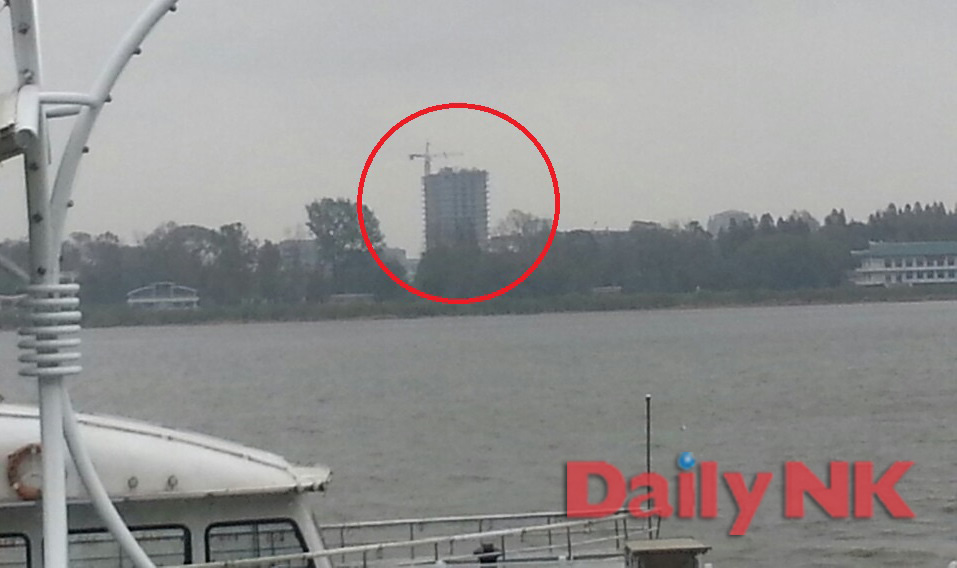
 A photo taken in early 2015 from Dandong looking over into Sinuiju shows a high-rise apartment complex at the height of its construction. Image; Daily Nk |
With fall wedding season in full swing and
an increasingly active black market for home transactions, property brokers in
North Korea are pocketing huge profits, Daily NK has learned.
“In the month of September, there’s been an
increase in the number of people buying and selling homes, so the real estate
market is really active,” a source in South Pyongan Province told Daily NK on
Wednesday. “Especially in the fall, there are a lot of weddings, so parents buy
homes for their children. Not only that, following the harvest, donju [new
affluent middle class], who have a lot of individual plots, use the money
they’ve earned from their harvest and buy homes.”
An additional source in the same province
confirmed this news.
For most home buyers, the issue of greatest
concern is whether they can purchase units within the rigorous legal
constraints citizens are, at least officially, bound. This is why more brokers,
who for the most part act as real estate agents, work with people from the land
management department under the Cabinet’s Ministry of Land and Environment
Protection to build expensive homes or tear down old ones and replace them with
new property so they can make more money, according to the source.
While selling homes in a system where
everything is nominally owned by the state remains technically illegal, people have managed to skirt around this hindrance by,
unsurprisingly, paying bribes to Ministry of People’s Security [MPS]
personnel and city management officials in in order to secure permits.
“These home brokers wield immense influence
over the MPS and city management office and are said to be scraping money in
with a hoe,” he emphasized.
Under normal conditions, those with permits
would only have permission to live in the homes and not sell them. Even after a
transaction is carried out, the city management office would maintain the right
to confiscate the home in question through the MPS. In actuality, however, as
more affluent people display a growing appetite for nicer homes, brokers are
capitalizing on this demand by selling the property illegally and paying off
state officials to overlook–and continue to permit–the burgeoning industry.
“Anyone who wants to buy or sell a home
needs to consult with a property broker,” the source said. “You tell the broker
what the layout of your home is and what the ideal selling price will be and
leave the keys with him or her. Then the broker goes out and looks for a
buyer.”
Brokers typically take prospective home
buyers around to ten places before they make their final decision. Once things
are confirmed, the broker has both parties sit down face to face, so they can
carry out the cash transaction and hand over the residential permit approved by
the city management office.
“Until just a few years ago, the broker fee
was very expensive for real estate, but now it’s typically about ten percent of
the property price,” the source said. Despite being illegal, money is enough to
surmount these obstacles–like most aspects of life in modern North Korea.
As long as one can provide the ten percent
fee, brokers handle the rest and have contributed significantly to growing the
nation’s real estate market, he explained.
With this booming market, brokers are able
to set aside more money for themselves. “A high-end apartment that was recently
built in Sinuiju trades for around 50,000 USD, so that ends up being a 5,000
USD sum for the corresponding broker to take away from the deal,” the source
concluded.
*The content of this article was broadcast
to the North Korean people via Unification Media Group.









