

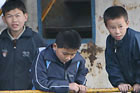
Reflecting on his school experience in North Korea, Chung Hyun Chul (pseudonym, 19), who entered South Korea in December 2008 after defecting from Buryeong in North Hamkyung Province, explained sadly, “I could not attend school even though I was of the proper age.”
He said, “Among my nine friends who lived in the same building and attended the same school as me, not one of them attended consistently. The circumstances of the children who could not attend school ranged from those who did not even have food to eat to those who just lacked clothing, shoes and notebooks.”
All of Chung’s nine friends were born in households which struggled to have three meals a day. Among them, two had parents who were traders, but their incomes were insufficient. Parents tend to be increasingly absent from home when household economics grow dire. In such circumstances, children travel in packs and often resort to stealing.
Nine friends, unable to attend school, resort to potatoes and corn
Chung recalled, “During the potato harvesting season we stole from potato farms, and in the winter season stole firewood. We would dig up the potatoes from fields as if they were our own. Our parents would then help us get them home.”
It is difficult to steal potatoes by yourself; it takes at least two or three people to transport that bulk.
In my neighborhood, people usually went to the potato fields after 9 P.M. We hid four or five 50 kilograms sacks on a hill located approximately 200 meters away and took only 25 kilograms sacks into the field, making sure that they are not spotted by guards.
Once they arrived, one person dug up the potatoes while another person followed him or her, placing the potatoes in sacks. When the bags were full, another person took them and transferred the contents into the bigger bag. Digging potatoes for three to four hours usually resulted in five full bags.
The children hid the full bags on the hill, so the parents showed up the next day with wheelbarrows to take them away. If someone inquired about the source of the potatoes, we said that we purchased them from the market.
Sometimes, the youths were caught in the act by guards, but they were usually released because of their youth and the fact that the guards do not own the fields so do not really care. On the rare occasion that one of the youth was caught by a relatively strict guard, then schools were contacted and a report was sent to the rations office, resulting in a decrease in food ration ticket allocation for the offending family.
Chung reminisced, “Every year when the potato season comes around, people try to supplement their food sources and buy other necessities by such means.”
Not even enough salt with which to eat the potatoes
In North Korea, the tradition of giving uniforms to students in commemoration of Kim Il Sung’s birthday ceased in the mid-1990s, so now it is up to individuals themselves to purchase the uniforms from the market. Among Chung’s friends living in the same apartment complex, four did not have enough money to buy uniforms and were forced to wear hand-me-downs from relatives or higher grade students. The remaining five used to purchase them once every two years.
Chung and his grandmother had to get by on a 1,500 won subsidy (350 won for him and 750 won for her) which was distributed by the neighborhood office every month. At the time, the money was only sufficient to purchase a kilogram of rice in the market. Buying school uniforms or shoes was not even fathomable.
The pair would buy 10 kilograms of corn for 350 won from the food ration office and would divide it up, eating 500 grams spread out over two meals per day. In other words, Chung and his grandmother shared an amount of food equivalent to that consumed by an average adult in a single day. In the cold winter season, they would sell the corn which they had received in the market in exchange for potatoes (50 won per kilo).
In 2007, a bag (1kg) of salt cost 50 won, five grams of single-usage Chinese seasoning salt five won and a bag of saccharine (5g), which is used in making corn cakes, 10 won.
When you are frugal with salt, it lasts about a month and a half, but if you use it to prepare side dishes, then it only lasts 15 days. A bag of saccharine disappears after making four corn cakes, so at least four bags, along with the seasoning salt, are needed each month. Thus, the monthly cost of salt, seasoning and saccharine exceeds 100 won. Five or ten won is nothing for the North Korean middle class nowadays, but 100 won is quite a burden for those struggling to make ends meet.
Unexpected fortune from wild boar hunting, prepare father’s sacrificial table
One of the activities on which the children focus in the winter is hunting. The citizens of Buryeong County lay traps to hunt animals such as wild boar, rabbits and pheasants, but catching a wild boar is the real success; they can be sold directly to merchants in the jangmadang without much preparation for 2,500 won per kilogram.
Chung boasted, “During the 2007 winter season, I tried it several times and caught small and large boars three times. Once, me and my friends caught a 150-kilogram boar.” He added that with the money gained from the catch he was able to buy winter cotton clothes, shoes and gloves for himself and his grandmother, as well as to prepare an offering for his deceased father.
However, wild animal hunting is not something that one can do freely. There are instances of forest conservationists taking away the animals and threatening to report the hunters to schools or the Party. Moreover, adult hunters steal the animals caught in traps laid by youths.
“When we stopped studying due to concerns about daily survival, I began to worry about my future. But because I believed that nothing would change even if I graduated from school, I had no ambition for my studies,” he said.
Since his arrival in South Korea, Chung has been looking to enter college. Right now, however, what he needs is a high school diploma. He continues to cling onto the goal of being able to take college entrance exams.
“I have never studied properly, so I do not know if my mind can take in all of this information, but if I do not study, then I will not be able to function as a human being. This was my first epiphany when I arrived in South Korea.”







