

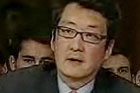
Ambassador Stephen Bosworth was clear; if North Korea does not return to the negotiating table, and fails to adhere to its prior commitments with regards to denuclearization, then there will be consequences, and the United States, he asserted, “is committed to doing what is necessary to protect the U.S. people and our treaty allies.”
“The choices for the future are North Korea’s,” Bosworth continued, “we will not accept North Korea as a nuclear state” but “nor are we threatening to change the North Korean regime by force.”
Bosworth was speaking at Thursday’s U.S. Senate Foreign Relations Committee hearing subtitled “North Korea, Back at the Brink?” The discussion, chaired by Senator John Kerry, was focused on what the next steps should be. It featured guest opinion from Ambassador Bosworth, America’s point man on North Korean nuclear negotiations, Victor Cha of Georgetown University, Korea Society President Evans Revere, the Social Science Research Council’s Leon Sigal and Mercy Corps President Nancy Lindborg.
Professor Cha spoke out in favor of sanctioning North Korea, asserting, and he was not alone, that the freezing of North Korean assets worth $25 million between 2005 and 2007, and the ripple effect it caused for other North Korean-held accounts, had more to do with getting Pyongyang back to the negotiating table than anything else. Since “the average North Korean doesn’t have an ATM card that they can use to take money out of the local Citibank,” Cha believes that similar financial sanctions only target the elite, don’t unduly affect the poor of the country, and might carry some weight.
Leon Sigal, however, suggested that in the longer term there can be no progress without leverage, and no leverage without engagement. Sigal asserted that Kim Jong Il cannot build the strong, prosperous nation that he has promised his people all by himself. Therefore, he needs to reach agreement with the rest of the world, and the rest of the world should be prepared to engage with him. Engagement, Sigal continued, “gets them dependant on us over time, and then we have leverage.” Sigal used the example of the New York Philharmonic Orchestra playing in Pyongyang and thus “undercutting years of North Korean propaganda.” According to Sigal, the reciprocal visit by North Korea’s state symphony orchestra has been held up for political reasons, and this is a prime example of an unproductive approach to the problems at hand.
What was clear from the discussion was that the U.S. has not given up on dialogue; all the panel members spoke out in favor of it, even if for some it was just the least bad option available. “I completely and bluntly disagree,” said Kerry, commenting on claims that diplomacy might be hopeless. Furthermore, whether the U.S. attempts to reinvigorate the Six-Party Talks, launches bilateral negotiations, or devises a new diplomatic architecture altogether, Evans Revere was certain, “Diplomacy, dialogue and mutual respect are more likely to yield results than policies of confrontation.”







