
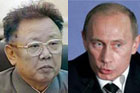
Vladimir Putin, the Russian president, signed the executive order for carrying Resolution 1718 related to North Korea’s sanction, adopted by the UN Security Council, on the 30th.
Accordingly, all government organizations and businesses inside the Russian Federation are prevented from exporting railcars, helicopters, and battle weapons to North Korea nor any materials possible for utilizing in developing nuclear weapons. Over 50,000 rubles ($1,950) worth of precious metals and accessories such as watches have been/are included in the export embargo.
Until now, Russia has played an important role in the nonproliferation of weapons for mass destruction (WMD) and in the/regarding the denuclearization of the Korean peninsula and there was even criticism that this signature resolution is not a renewed policy from its clearly expressed position in the denuclearization of the Korean peninsula. However, there has not been a shortage of criticism announcing a practical resolution that has been stipulated is a form of pressure to North Korea.
Taking this one step further, domestic experts evaluated that Russia agreed with the UN sanctions against North Korea not only to threaten North Korea but to increase its influence in international society as well as on the Korean peninsula.
◆ Russia, North Korean policy changing? = Russia has sought a diplomatic resolution for North Korean nuclear weapons in regards to carrying out UN Security Council’s North Korean sanctions, which is inconsistent with the U.S. and Japan.
Myongji University Professor Lee Ji Soo said, “Russian President Putin has a definitive stance on North Korean problems such as its nuclear weapons, even to the extent of calling Kim Jung Il ‘a deranged person.’”
However, the information intelligence bureau and the national defense bureau’s leaders have traditionally had close ties with North Korea, so Professor Lee’s explanation was that there cannot be a fundamental change in the policy towards North Korea. The transformation in the North Korean policy is rooted in the human reshuffling.
He expressed, “Through studies at Kim Il Sung University, they have made relationships with North Korean leaders and a part of them have thickened intimacy while engaging in diplomatic activities in North Korea. Agreeing with the UN sanctions against North Korea like this time can be seen as that Information Intelligence Bureau’s and National Defense Bureau’s leadership has been reshuffled. From now on, Russia’s North Korean policy will demonstrate a fundamental change.”
◆ Russia, intends to intervene more in-depth in the North Korean nuclear issue? = Points have also been made that in the dimension of heightening its influence on the Korean peninsula, Russia intends to directly oversee the North Korean nuclear issue.
North Korea, until now, has tried to curb China’s influence, due to its strong economic reliance on China, by exaggerating its “secret relations” with Russia. After the most recent February 13 agreement, the North, by showing an actual improvement in its relations with the U.S. by using nuclear weapons as leverage, has raised Russia’s anxiety.
A professor at an international policy research institute, who has requested anonymity, provided the analysis, “Easily put, Russia has felt badly regarding North Korea’s attitude. From the perspective of restraining China, North Korea has seriously considered Russia’s role, but recently, with this setup shattered, Russia’s location regarding the nuclear issue has become narrower.”
Furthermore, he said, “North Korea, by prioritizing China (related to the North Korean nuclear issue) and dialoguing with the U.S., has had decreased Russia’s influence on the Korean peninsula. Russia, through its agreement with the sanctions against North Korea, has raised/heightened Russia’s presence in regards to North Korea and will unfold a strategy of fostering its influence.”
He added, “Russia’s North Korean policy will not fundamentally change. While discussing pending questions with North Korea regarding the Trans Siberian Railway (TSR), Russia will raise its level of leverage.”
◆ Russia, will not allow North Korea’s nuclear weapons as an obstacle to the Korean peninsula’s Joint Economic Organization = Russia has shown significant influence in building a joint economic organization on the Korean peninsula. Through the TSR and the Trans-Korea Railway (TKR)’s energy development issue, it has heightened safety and welfare from the dimension of each country’s economic development.
Additionally, the analysis has been made that the consciousness of problems due to North Korea’s nuclear and missile experiments have actually threatened the security of the Far East region. It seems to have agreed to North Korean sanctions from the perspective of the increasing difficulty in overlooking the North Korean nuclear issue which has continuously been threatening the region’s security.
The criticism of Leonid Slutsky, Deputy Head of the Duma Foreign Affairs Committee can be interpreted as “Such policy (nuclear development) by North Korea cannot be allowed and is introducing a threat to regional security.”
Russia, in particular, has shown a strong will in the North-South Korea and Russia’s economic cooperation for increasing domestic rights and privileges in North Korea and developing the Far East region, which has been falling behind.
Vladimir Rakhmanin, Russia’s Main Consulate who visited Korea on the 28th, emphasized economic cooperation in the East Asian region at a seminar sponsored by Korea’s International Exchange Organization. He said, “The economic and safety threat to the Far East Asian nations will be helped by resolving the North Korean nuclear crisis and the securitization of the Far East Asian region.”
Svetlana Souslina, a Moscova International Relations University professor who participated in the seminar, stressed the active mediation role of Russia, saying “Russia has already become a market economy nation and this tendency will become stronger. Thus, Russia will take on the role of uniting the East Asian region”