

Despite Wednesday’s claims to the contrary, Russia says it has not rejected a draft UN Security Council resolution on North Korea.
On June 10th, Yonhap in South Korea released news that, “Russia has rejected the latest version of a draft U.N. Security Council resolution to punish North Korea’s recent nuclear test, taking issue with wording on Pyongyang’s missile program,” citing a diplomatic source.
However, the Russia Foreign Ministry was quick to rebuff the claim, telling Russian news agency Itar-Tass, “This has nothing to do with the reality… The Russian delegation has not rejected any drafts.” The Ministry also said, “We continue to take the most active part in the work on a compromise document… We expect it will be finalized in the near future.”
Later on Wednesday, Yonhap released a further report which corroborated the Russian Foreign Ministry view, again citing an anonymous diplomat as saying, “The five permanent members of the U.N. Security Council — the U.S., Britain, France, China and Russia, and South Korea and Japan — have agreed on a draft resolution on North Korea’s second nuclear test… The draft has been circulated to all the 15 members of the Security Council and we expect it to be put to a vote Friday.”
Then, when the sun came up over Washington, State Department spokesman Ian Kelly was confident, “I know that there has been an agreement on a draft resolution among the perm reps from the P-5+2 countries. That’s the five permanent members of the Security Council plus the permanent representatives from South Korea and Japan,” he announced, though he was quick to point out that deliberations among the full Security Council had yet to be completed.
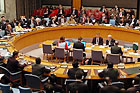
The resolution requires nine votes from the fifteen members of the full Security Council in order to pass, including the votes of all five veto-wielding permanent members. The current elected members of the Council are Burkina Faso, Costa Rica, Croatia, Libya and Vietnam. With both Libya and Vietnam allegedly displaying some sympathy with the North Korean position, the passage of the resolution is not yet certain.
Furthermore, the draft resolution is written under Article 41 of UN Charter Chapter 7, and as such does not carry with it any provision for the use of force. This is causing some experts to question the likelihood of its having any real effect on the behavior of Pyongyang. In a blog post from the Heritage Foundation, a conservative think-tank, on the 10th, director of the Asian Studies Center Walter Lohman was dismissive, “The Chinese and Russians prevented a tougher resolution, and will continue to prevent effective enforcement of this one. And that will be the problem. Like the others, it will be ignored.”
In Seoul, Minister of Foreign Affairs and Trade Yu Myung Hwan was more upbeat, telling the Diplomacy, Commerce and Unification Committee of the National Assembly on the 10th, “The UN Security Council resolution will not come to nothing in a situation where North Korea’s intention to develop nuclear weapons is so clear.” He also added, “The power of the resolution to compel member states is considerable because the resolution invokes UN Charter Chapter Seven.”
In any case, while the resolution again calls upon North Korea to refrain from any further nuclear tests or missile launches, in an anonymous release to Russia’s Interfax, a senior military source in the Russian General Staff said he had “certain information on the type and characteristics” of a rocket currently being prepared for launch in North Korea.
However, the source announced, “There is no precise information on the timing of its launch.”







