

It seems that Russia is not convinced of the reliability of North Korea’s missile technology, and has therefore taken steps to defend against stray North Korean armaments.
Speaking in Ulan Bator on Wednesday, the Chief of the Russian General Staff, General Nikolai Makarov announced that Moscow has deployed an advanced missile system in the area.
“We have deployed an S-400 battalion [in the Far East] already,” General Makarov explained, “We are taking these preventative measures as a security guarantee against faulty launches of the [North Korean] missiles and to guarantee that fragments of these missiles never fall on Russian territory.”
The S-400 is a modern surface-to-air missile system designed to detect and engage aircraft, cruise and ballistic missiles travelling at up to 4.5km/s.
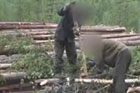
Meanwhile, investigative reporter Simon Ostrovsky, known for his work in remote locations, has made a film detailing the lives of North Koreans working under the protection of the S-400s in logging camps in Russia’s Far East.
The remote camps, part of an agreement between Kim Il Sung and Soviet Union General Secretary Leonid Brezhnev signed in 1966, originally contained between ten and twenty thousand North Koreans, mostly prisoners, although more recent working visa holders have apparently been urban dwellers seeking to escape the grinding poverty of their North Korean hometowns.
North Korean loggers interviewed by Ostrovsky said that they earned up to $250 per month, although payment is erratic or non-existent at times. The North Korean state apparently takes 35% of the proceeds, which amounts to some $7 million per annum, while the rest goes to an Anglo-Russian logging firm called Tynda Les.
According to the testimony of a North Korean defector who escaped one of the logging camps in the 1990s and was interviewed for the film, “I was working endless hours. Twelve hours is normal in North Korea, but working 12 hours at the camps is very hard. In winter it’s very cold… It’s hard to work on an empty stomach. But the living conditions were the worst part.”
“The logs cause injuries. The drivers drop logs and people get killed. Because people are so cold, they can’t avoid falling trees and are killed.”
Nevertheless, the CEO of Russian Timber Group, which owns Tynda Les, told Ostrovsky that the camps comply with Russian labor law, although the pay of the North Korean workers was not their choice to make.
Simon Ostrovsky’s film was due to be broadcast in full on the BBC news analysis show Newsnight on August 26th, 2009.







