

[imText1]After the Roh Moo Hyun Administration took office, the tendency of excessive democracy has appeared obviously. Examples of demagogic politics and popular policy include the sunshine policy, relocation of the capital city, equal policy and disputes in the income gap.
Following the June 10 Resistance in 1987, the Republic of Korea became a democracy. However, many argue that the nation has yet to enter into a world of freedom as a result of excessive democracy and populism.
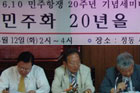
In commemoration of the 20th June 10 Democratic Resistance, the Sunjinhwa Association held a seminar “Evaluating 20 years of democracy” at Cecil Restaurant, Seoul on the 12th. Professor Park Se Il of Seoul National University said, “One of the greatest obstacles to liberalism is populism which violates individual freedom and basic rights” directing the remark to the Roh Moo Hyun government.
He analyzed, “South Korea entered its first stage of democracy in 1987, however has not yet entered the second stage” and asserted, “The people’s freedom and basic rights must be considered and the vote by majority vetoed.”
Further, the professor said, “The greatest threat to liberalism is populism” and elucidated, “If demagogic politics appears, the people will be stimulated not with rational thoughts but by emotions which in the end could easily incite a government who will ignore freedom and basic human rights.”
The professor explained four factors needed in order to overcome populism and adopt liberalism; the govern of law must be established, a liberal constitution must be settled, the balance of power between members of National Assembly and public workers of governmental organizations and people’s awareness of republicanism.
Professor Park criticized the Roh Moo Hyun government, “Discourse on demagogic politics and populism is on the rise” and warned of the dangers of a democracy with no freedom arguing that, “negligence, illegal actions and evasion of law by organized groups and public power is also increasing.”
Pastor Suh Kyung Suk said, “These extreme situations are becoming increasingly noticeable under the Roh Moo Hyun government, such as through over-exaggerated principles, populism, mass egoism, use of language on the internet, people’s movements, divisions between groups, negligence of law and formal democracy, excessive requests of ideological freedom, excessive equalization, excessive democratization and the destruction of traditionalism and community.”
The reason for this excessive democracy is because “These oppressed groups are letting their emotions out as they are at conflict with one another” and used the example of the people’s movements such as the grassroots’ presidential election movements in 2000, the candle-light demonstration against the US soldiers’ and the movement for removing the General MacArthur’s statue in Inchon.
During the seminar, many people argued that South Korea had made progress towards democratization following the June 10 Resistance, however agreed that there was still a long way to go.
Hong Jin Pyo, executive director of Liberty Union said, “Many forces in the current administration argue that the South Korean society lacks democracy, however this is a great mistake” and suggested that there were not many fundamental defaults to the democratic system.
Rather, he commented that “On observing the privileges of grassroots organizations which fought for democracy in the past, privileges of large scale’s laborers’ unions, you can see new grievances that have arisen” asserting that the excessive domocracy phenomena was blocking the road to democracy.









