

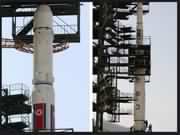
Yesterday, North Korea announced that the window for the launch of its upcoming long-range rocket has been extended by a week to December 29th. Although the move has surprised a number of experts, the rocket motors in question are well tested, having been designed based on those used in the Soviet-era Rodong missile, and this leads South Korean experts to believe that the launch will be possible within the window.
According to the December 10th Chosun Central News Agency (KCNA) report announcing the delay, “As per the statement released previously, Chosun’s scientists and technicians are in the final stages of preparing for the launch of the second version of the scientific and technical satellite ‘Gwangmyungsung-3.’
“In the process, a technical fault has been discovered in the first stage steering motor module of the delivery rocket, so the expected launch date has been extended to December 29th.”
The announcement came one day after KCNA released another less detailed report noting the possibility of a delay, which itself came one day after the South Korean government received intelligence that rocket components were being transferred from a research institute in Pyongyang to the launch site in Cheolsan County, North Pyongan Province.
According to experts, there is a high likelihood that the problem stems from the equipment used to control the power output of the motors in the first stage of the delivery rocket. Given that more than 70% of the motive force of the rocket comes from the first stage, without full control of that step in the process, the entire launch becomes practically impossible.
Professor Kwon Sei Jin of KAIST explained to Daily NK, “If you are aiming to control the first stage of the rocket, then regulating the input of propellant is very important. As a result, if there is a problem in that sector then the launch itself becomes tricky. However, it is also a simple question of replacing the parts in question, so the launch is probably still possible in the timeframe suggested.”
“The first stage of the North Korean rocket has been used and tested in the Rodong missile for 20 years, and has been tested in Iranian missile launches as well,” Kwon went on to point out. “They have a developed infrastructure for the production of engines, so as long as they know what the problem is, they should be able to fix it and launch within the launch window.”







