

North Korea’s city residents are in the
midst of furious preparations to block against the impending winter chill.
Daily NK has learned that charcoal briquette makers are under the spotlight
these days, as they struggle to keep up with demand. These residents are
earning their wages by purchasing the coal in bulk and making briquettes
themselves using machines.
In a phone conversation with the Daily NK
on the 13th, a source in South Pyongan Province said, “Since around September
or early October, all the residents have been absorbed in winter preparations. Such preparations include making kimchi and installing a heating device. The
biggest expense is the heating fee so residents begin saving for charcoal in
the early fall.”
A separate source in the same province and
an additional source in North Pyongan Province reported the same trend to Daily
NK.
These charcoal-fueled heaters are said to
“give off the heat of the summer sun in the middle of winter.” Noting that the
hardest part of winter prep is trying to find ways to stay warm, she explained
that residents first pour their energy into market activities in order to
save up enough to purchase a heater and fuel in one fell swoop. As consumer trends have climbed
in recent years, the number of competing services has also risen.
“Case in point: now residents can purchase
ready-made charcoal briquettes,” she said.
“Cadres, donju (literally money masters, or
new affluent middle class), regular market traders, and housewives have all
started flocking to the briquette makers, who enable them to save time and
money. The briquette makers buy powdered charcoal and squeeze it into form,
protect and store the briquettes, and finally transport them. It’s no wonder
that demand is rising.”
Rising demand calls for increased systematization, which the most successful in the fledgling industry have been quick to implement. The strenuous task of mixing the
powdered charcoal with mud and water then squeezing them into form is usually
left to the young men while the chore of putting the dried briquettes into storage
and transporting them is usually left to the women. Teenagers and older folks
stand guard overnight to protect the goods and paid 1 kg of rice (6000 KPW/ USD
.72) daily for their services.
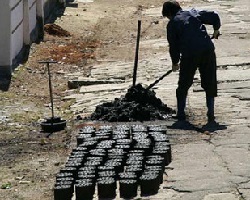
“It’s a rather unusual scene for the
autumn: charcoal makers and charcoal bricks spread out on roads, alleys, and
front lawns. But now that charcoal making has become commercialized, we see a
wide variety of people earning money through the enterprise,” commented the
source.
“One ton of charcoal used to yield
approximately KPW 10,000-20,000 (USD 1.21-2.42) in daily wages for the makers.
However, now that the briquette size has been standardized through the use of
machines, the workers are paid by the number of bricks they produce. A single
briquette yields KPW 50 (about half a US cent). The employers typically hire
young men in pairs to undertake the work.”
According to Daily NK’s sources, the price
of coal can depend on its mine of origin, how well it retains heat, and where
it is being sold. In Pyongyang the price of one ton of coal is USD 20-30, but
those prices shot up in the spring and fall. Usually, one can produce
approximately 350 briquettes from one ton of charcoal, but using the new
machines, it is possible to make between 500-600 briquettes from the same
amount of material.








