

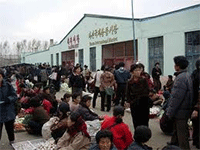
Market prices in North
Korea continue to respond well to the execution of Jang Song Taek, Daily NK has
learned.
According to inside
sources, on December 20th good quality rice was trading at 4000 won/kg in Pyongyang, 4900 won/kg
in Sinuiju and 4600 won/kg in Hyesan. These prices are 1100, 500 and 1200 won lower
respectively than they were in mid November.
Several factors may be
playing a role. Early in 2013, a portion of wartime rice reserves was released.
In addition to this, the distribution of food by the state has been more
reliable than normal for much of this year. There was also a good harvest of potatoes, corn and rice, which has brought down market prices. Finally,
the state did not implement market controls in the wake of the execution of
Jang Song Taek, which has played a part in facilitating the circulation of
goods.
One source from Hyesan
in Yangkang Province informed Daily NK on the 26th, “Markets
were only restricted briefly during the mourning period for the General [Kim
Jong Il], and trading has returned to normal now. Restrictions were anticipated
following news of the sudden execution of the aunt’s
husband [Jang Song Taek], but that didn’t happen.”
“Large amounts of rice and vegetables were given
in payment to workers in mining areas of North Hamkyung Province,” the source also went on. “These products then circulated to other provinces like Yangkang. The
Upper [the authorities] also gave out rations of corn and rice, which means that
there is quite a lot of rice in the market.”
A source from
Pyongyang also reported, “The rice price started gradually dropping in
mid-November. It was at 4800 won at the start of December but by the
middle of the month it had fallen all the way to 4000 won. This has
traditionally been a time when rice prices fall as products siphoned off during
the threshing period begin to appear in the markets. However, a drop of
around 1000 won in a month is highly unusual.”
“Thanks to the continual distribution of rations and
these payment-in-kind wages for some enterprises, an increasing number of people
are looking to buy side dishes rather than rice,” the source explained. “Now many grain traders have left the market and are harder to find.”
Meanwhile, the US
Dollar exchange rate in Pyongyang, Sinuiju and Hyesan climbed by 300, 110
and 120 won respectively in the period since mid November, reaching 8400, 8260 and 8300 won
respectively.
On this, the Pyongyang
source commented, “Generally the exchange rate runs parallel to the
rice price and the two rise and fall together. But recently this has not been
the case, as the number of people wanting to save their newly increased wages in
US Dollars is growing.”








