
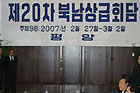
The 21st Inter-Korea Cabinet Talks began on the 29th and will continue until June 1st. The four day meeting will take place at the Grand Hilton Hotel, Seoul.
26 members of the North Korean party including Cabinet Secretary Kwon Ho Woong departed Koryeo Airport at 3.50PM to arrive at Incheon Airport later in the afternoon.
This is the first time in 3 months that a meeting is being held since the last Inter-Korea Cabinet Talks that took place in February. Following his appointment, the Minister of Unification, Lee Jae Jung has been proclaiming “normalization of South-North relations and systematization of South-North meetings” that will be unshakable by political issues. It seems that the current talks will be the first test to see if this proclamation can be applied.
In particular, the talks begin with the understanding of reserving rice aid while the February 13 Agreement was not yet fulfilled. In the worst case scenario, some argue that the talks could end in vain.
Whether the South Korean government is aware of this possibility or not, it seems that South Korean representatives are making additional efforts to ensure that the talks do not become uneasy because of the issue of reserving rice. It is clear that Minister Lee is also making extra efforts.
On the morning of the talks, Minister Lee said that there had never been any intentions to associate rice aid with the implementation February 13 Agreement of North Korea. He then added, “A variety of other conditions have led to the postponement of the rice aid” as if to avoid irritating the North Korean delegates.
When questioned whether North Korea will object to the postponement of the rice loan (a total of approx. 204.7mn dollars including the purchase money of 500,000tons of rice and delivery fees), Minister Lee explained, “I do not believe that will happen. It’s not that we can’t give it to them, it is merely an issue of delaying the rice temporarily.”
Despite Minister Lee’s words, signs from within the Ministry of Unification suggest that North Korea will be disgruntled by the South Korean government’s decision to postpone the rice.
Moreover, a North Korean spokesperson asserted on the Chosun Shinbo run by the Jochongryon on the 28th that South Korean authorities were associating the rice aid to North Korea’s implementation of the February 13 Agreement and stated, “The North does not agree to this.”
If the South Korean is able to convince North Korea that the rice loan was merely being delayed, then there should not be any hindrances to the progression of the talks.
Through the talks, the South Korean government plans to discuss proposals pertaining to ▲ peace on the Korean Peninsula which includes building military trust ▲ humanitarian work relating to abductees and prisoners of war and ▲ economic activity which includes opening up railroads and passages to Kaesung Industrial Complex.
In addition to discussing issues related to peace on the Korean Peninsula, the South Korean government plans to stress the importance of the February 13 Agreement and offer proposals that include building militaristic trust and easing militaristic tension.
Specifically in regards to military issues, the government aims to discuss establishing stationed delegate offices in each side, opening talks on national defense, regulating and inspecting military power between the South and North, establishing a direct military communication line and informing preliminarily of relocation large scale brigades or military trainings, amongst other issues.
However, in the past North Korea has shown reluctance in discussing military issues and some analyze that it would be difficult to ascertain any concrete negotiations. This we will have to wait and see.