

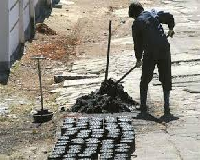
With winter fast approaching, many North
Koreans have already started gearing up for the cold, and with this, demand for
South Korean hot water hoses has spiked, Daily NK has learned.
“These days, using hot water heating
powered by coal briquettes is popular,” a source in South Pyongan Province told
Daily NK on Thursday. “But it’s hard to get the hot water hoses from the South
even if you offer high prices.”
Two additional sources, one in North Hamgyong Province and one in South Hamgyong Province, corroborated this trend, noting it to be most prevalent among city dwellers.
Traditionally, the average single-floor
homes or apartments of laborers and farmers are heated with coal or wood
directly from a furnace. Once ignited, the fuel sends the heat directly through
the floor. In the case of Pyongyang, until the 1980s homes had steel pipes
running through the floors but would later face chronic problems such as
corrosion and loss of heat efficiency.
These days, what people put the most care
into is renovating their homes to create an area of flat slabs of stones for
ondol (Korean floor heating system).
“They create winding channels in the cement
floors and then install a plastic hose that’s the width of your pinky finger to
let hot water pass through,” he said.
“Once you install the plastic hose, you
need to be able to use it for some years, so products from the South are the
most popular,” the source said. “At the general market, they have ones that are
produced in Pyongyang or Hamheung as well as Chinese goods, but a lot of them
can’t withstand the heat and soon burst.
Added the source, “The ones from the South
stay the same in terms of diameter, and they don’t burst open either; some say
that a bit of supply of these South Korean goods comes from the (inter-Korean)
Kaesong Industrial Park, but most are imported in from China.”
Families that renovate their homes for
heating usually install a copper pipe of 15-20mm in the briquette heat
preserving hole that’s in the kitchen. From there, they extend a heater hose to
run hot water through. This method was thought to be
used in South Korean homes in the past as well.
“In the past, with the direct furnace
heating system, even using five to six briquettes, people were not able to
distribute the heat equally across the floor,” he said, explaining this
has helped spread the water heating system among the general public.
The South Korean goods that are circulating
for this new heating system are not specified by make, unlike handsets from
the South, which come with particular brand recognition for Samsung. However,
the goods are still known for their good elasticity and durability, setting
them apart from local or Chinese products. North Korean plastic hoses sell for
500 KPW (0.06 USD) per meter, while Chinese ones go for 1,000 KPW (0.12 USD). Even though South
Korean hoses fetch 5,000 KPW (0.58 USD) for the same length, their popularity means the
supply is never sufficient, according to the source.
This trend in hot water heating is thought
to have trickled in from China. Since the mid-2000s, new apartments in China
have been influenced by South Korean culture and instead of coming with the
bare structure, apartments are now built with floor heating and interior
designs modeled after the South.
The change in construction practices there
have likely started to flow into the North, influencing their home heating
systems as well.









