

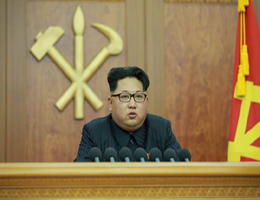
In Kim Jong Un’s 2016 New Year’s Address he advocated economic development and other similar policies with the purported
goal of improving the lives of the people. He also omitted the nuclear narrative, a point that garnered significant international attention and analysis. Reactions from the domestic public,
however, were in line with past years–tepid, predominately focused on criticizing the oration as “nothing more than a token gesture
unworthy of attention,” local sources reported.
On the 4th, our Daily NK reporter spoke
with a source in North Hamgyong Province, who told us that among the first
people of the year mobilized to produce organic fertilizers, including night
soil, the speech was termed a “sham” and “useless.” Many pointed out that last year’s address targeted
agricultural, livestock, and fishing as sectors for development to increase the quality of life for the average citizen, but underscored having “yet to receive, even
once, any fish or pork” from the state.
Sources in Yanggang and South Hamgyong Provinces corroborated this news.
Despite the fact that “improving the lives
of the people” is mentioned without fail annually during the New Year’s
address, the regime continues to expend its energy on idolization of the
leadership rather than pursuing policies that might actually make any tangible
difference to the people, she said, noting, “ Following last year’s
speech, the state invested in construction of statues of Kim Il Sung and Kim
Jong Il [rather than, for example, desperately needed infrastructure improvements].”
North Korean citizens who are currently
suffering through an intense cold spell are “tired of these empty promises.”
Complaints are numerous: “Every year we have to produce more compost, and yet
we have never received adequate supplies,” beleaguered residents point out.
“Even though the regime promises economic development, we continue living purely
owing to our own efforts without any real support from the state,” still others
protest, many of whom reminisce about a different era.
“Kim Il Sung actually carried out his
promises to the people but now it’s all just words,” is a common
sentiment weaving together the older generations in the North, according to the source.
Including the sources, many residents contest
that the “successes of the fisheries development efforts” referenced in the New
Year’s Address can be attributed to the inclusion of fish caught in the ocean
that “would have been caught there anyway,” and the lack of any mention of
livestock this year “implies that the efforts to develop the livestock industry
[as outlined in last year’s prescriptions] failed.”
“Overall, the accomplishments of the
current era pale in comparison to what the state achieved in the 80s; people do
not sincerely believe in the Party and are more focused on making their own
living than they are on working for the sake of the nation. This is why it is
difficult to accomplish the goals laid out in the New Year’s Address,” our
source mused.
“People say that even if the fish are
abundant, they are all eaten up by the military, and ordinary citizens have
only the jangmadang [markets] as a recourse to providing for themselves. In
this year’s New Year’s Address, they stated that ‘the overwhelming fragrance of
the oceans and fruits have brought joy to the people,’ but the only person in
the country who eats as much fish and fruit as they want is Kim Jong Un.”
On the face of it, residents trudge along,
making resolutions and promoting the objectives of the New Year’s address; yet, behind closed doors, criticism is rife, and most people simply do the minimum
required to pass off their efforts as convincing as they are too caught up in
the struggle of daily life to commit.
In other words, as our source put it to us,
“to the average North Korean, the New Year’s Address is nothing but a routine
exercise that is carried out at the beginning of each year, an irritating task
that must be taken on.”









