

[imText1]“Tourists can see a lot, even if we don’t always know what we are seeing.”
It’s a perennial problem, that anthropology is best not attempted from behind the windows of a tour bus. In North Korea this fact is only amplified by both official reluctance to allow freedom of movement outside strictly defined limits, and the tendency on the part of guides to make claims about some things tourist observe which can best be described as misguided, and at worst outright misleading.
However, entering as an anonymous tourist to evade government press restrictions, a reporter with Dutch broadcaster “Radio Netherlands Worldwide” has provided a rather more interesting glimpse into North Korea from the tourist perspective. Combining tour footage with an interview with Jaap Timmer, an aid professional who spent three and a half years working with the International Red Cross in North Korea, the report provides a small peek behind the façade of life in the Pyongyang area.
To the uninitiated, North Korea’s capital looks like a well-organized, clean and reasonably comfortable place to live, and compared to the rest of North Korea it really is. There are trolleybuses, generally of a fairly aged variety, there are restaurants, though they are out of range for the man-on-the-street, there are stores, somewhat poorly stocked, and there are rations, most of the time. However, as Timmer pointed out in the video by way of a couple of examples, the people of Pyongyang also suffer hardships on a daily basis.
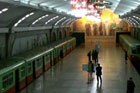
The Pyongyang Metro is the first stop. It’s a fine example of the Stalinist school of design that characterizes the subway systems of many Communist and former-Communist countries to a greater or lesser extent. It runs deep underground, taking its lead from the Moscow subway and doubling up as a bomb shelter. It has some fine murals, and the Rodong Shinmun is always around for the public to read while they wait for the train. However, problems persist. According to Timmer’s commentary, “They make sure there’s electricity if there are foreigners around.” He explained further, that his secretary “preferred to walk because she knew when she’d get home,” since frequent power shortages made the journey by subway highly unreliable.
Moving on, we see some reasonably attractive looking apartment buildings, the like of which adorn the sides of most major thoroughfares in the capital. Within, however, the story is a little different. The elevators don’t work, Timmer explained, “So people on the upper floors are younger.” Logically enough, “When you get older, you move down!”
And so it continues. An interesting glimpse behind a unique city.







