

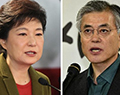
The first North Korea and unification policy debate since the shock withdrawal of independent candidate Ahn Cheol Soo took place on November 28th, with a bipartisan group of South Korean academics discussing the pressing issues as December looms.
Hosted by the Hansun Foundation, the event saw professors Choi Dae Seok of Ewha Women’s University and Koh Yoo Hwan of Dongguk University explaining the policies of the two candidates, followed by a broader debate.
In doing so, the two academics revealed radically different views of the future, but far less divergence when assessing the policy of the outgoing Lee Myung Bak administration.
“We may evaluate highly the current administration’s policy of sticking to principle in dealings with North Korea,” Choi, a conservative, asserted. However, he went on, “They did not manage inter-Korean relations well, and focused much too heavily on denuclearization, which is a very hard issue to deal with.”
Progressive Koh agreed with the latter sentiment, saying, “Despite the enhancing of sanctions at the UN level and South Korea’s own May 24th Measures, North Korea’s nuclear capacity has increased and so has the scale of its provocations.”
“Of we are to restore inter-Korea relations, the June 15th and October 4th declarations must be implemented and developed upon,” he then went on to assert, parroting the Moon Jae In camp’s policy prescription.
Other academic experts then added their voices, noting that both candidates must rapidly develop their policies, and stop relying on broad assertions.
Senior researcher Cheong Seong Chang of the Sejong Institute pointed out, “Park is more flexible than the Lee Myung Bak administration; however, she is still stuck on the introduction, and lacks specific policies.”
Referring specifically to Park’s election pledge about ‘bringing about significant change in North Korea,” Cheong was critical, saying, “She didn’t even explain what ‘meaningful change’ is, and did not offer up any policy options, either.”
Professor Cho Young Ki of Korea University agreed, pointing out also, “Even if South Korea does have a flexible policy on North Korea, they will not walk obediently to the negotiating table. A flexible policy could be seen as a unification by absorption strategy by North Korea.”
On the other side of the aisle, Professor Hong Sung Ki of Aju University declared Moon’s policy to be little more than ‘Sunshine Fundamentalism,’ “An extension of the previous sunshine policy, and practically blind faith.”
“The North Korean regime has clearly stated that it will not accept the Sunshine Policy goal of reform and opening, and therefore Moon’s inter-Korean economic union theory is hopeless for both Koreas,” he added.







