

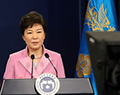
During her first press conference of the year yesterday,
President Park Geun Hye spoke of the need to hold separated family reunions
between North and South Korea. Coming hot on the heels of Kim Jong Eun’s
relatively mild-mannered New Year’s Address, in which the North Korean leader at least noted the
objective of improving inter-Korean relations, Pyongyang’s response is now in the spotlight in South Korea.
Experts have reacted cautiously to President Park’s words,
implying that they are not sure how the Kim regime will respond.
From the North Korean perspective, the isolated nature of
separated family reunions carries a limited political burden. Furthermore, such
a gesture has the potential effect of engendering better relations with both China and the United States
in the short term.
On the other hand, there are plenty of reasons why Pyongyang could opt to reject
the overture from Seoul. It is not even the case that North Korea has been playing nice ever since the New Year’s Address. Shortly after Kim
mentioned South Korea in somewhat passive terms on January 1st, the Committee for the Peaceful
Reunification of the Fatherland (5th) and Rodong Sinmun (6th)
both heavily criticized the South Korean decision to hold military training
exercises.
Moreover, the Park administration has not made any financially or politically beneficial offer to the North to go along with the call for reunions. This does not bode well.
The two Koreas previously agreed to hold a new round of
separated family reunions from September 25th to 30th at
the Mt. Geumgang tourist complex in late September, and planned further meetings
via video link in October planned and a round of reunions in November. However,
four days before the first of these events the North unilaterally postponed all
schedules.
At the time, the North accused South Korea of taking a
confrontational stance and then attempted to put responsibility for the
failure of the reunions onto Seoul. However, few believed the North Korean
claims. Rather, the move was widely seen as a result of dissatisfaction at the
attitude of the South Korean government, which had moved to decouple separated
family reunions (a humanitarian issue) from the restarting of the Mt. Kumkang
tourist complex (a business, and thus profitable, one). Even if North Korea agrees to talk about
reunions now, it is assumed that Pyongyang will inevitably seek to connect it with the regime’s
own perceived interests.
It is the position of the South Korean government that the two
issues are to be dealt with separately, but Seoul said previously that negotiations on Mt.
Geumgang could commence if and when the separated family reunions took place. If such
a position were to be voiced again, it may well be possible for talks to
progress in some substantive sense.
Professor Cho Yong Ki of Korea University told Daily NK, “The
direction in which capricious North Korea turns is important,” adding, “It’s
not impossible that they might reject [the South Korean proposal] completely, but
they can’t afford to just throw the whole thing away. They will probably utilize it
for political goals; they won’t simply accept it in its pure form.”
Professor Cho went on, “If North Korea is sincere and truly
desires South-North dialogue then they must deal with the separated families
issue unconditionally and on humanitarian grounds. Whether the reunions take
place can be used as a barometer for the future of relations.”
A second North Korea expert also shed light on the issue, stating,
“Since North Korea made reference to improving South-North relations in the New
Year’s Address there is the possibility that they will accept the reunions. Even
so, rather than responding positively and directly to the South’s demands, they’ll probably drag their feet in order to create conditions more favorable to them.”
Elsewhere, the South Korean Ministry of Unification reached out
to the North in accordance with Park’s suggestion yesterday, proposing working-level
talks on the 10th at Panmunjom.







