

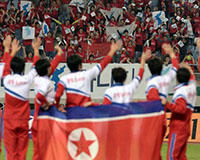
North Korea’s success at the 2014 Incheon Asian Games has
seen a high level of interest from residents in Pyongyang as they gather in the
streets to watch recorded footage of the North Korean athletes’ gold-medal performances
at the competition.
“Wherever Pyongyang residents go, be it the the subway,
trolley, bus, etc., everyone is talking about nothing but the Asian Games
taking place in South Korea,” a source in Pyongyang reported to Daily NK on
October 2nd. “Whenever there are matches between North and South Korea on the
big screen at Pyongyang Station, everyone stops to watch.”
South Korea’s three main local broadcast stations, Munhwa
Broadcasting Corporation [MBC], Korean Broadcasting Station [KBS], and Seoul
Broadcasting System [SBS] extended broadcasting rights to North Korea for free
so that North Koreans could also have the option to watch the Asian Games.
However, according to the informant, North Korea has only
been showing footage of the North Korean teams’ winning matches, likely as
propaganda to demonstrate the full grandeur of their athletic superiority,
attributed to “the greatness of Kim Jong Eun.” For instance, in the case of the
women’s soccer semifinals, the entire match was broadcast to show the North
Korean team’s victory over South Korea.
The “establishment of North Korea’s athletic superiority”
has been a recurring theme since Kim Jong Eun took power. The Asian Games
sparked such a marked interest in him that he not only took on himself to watch
the teams practice, but often even took on a directional role. Because of his
increased involvement, despite the fervor with which the participants have
played, some have concerns for the athletes who are to return back home to
North Korea.
“Just the fact that the Asian Games took place in South
Korea posed a problem, but an even bigger issue is that Kim Jong Eun became
directly involved in the coaching process,” the source said, conveying
sentiments by many of the residents in Pyongyang. “While losing to China or
some other country is not a big problem, losing to South Korea or Japan could
hold dire consequences, resulting in strict punishment.”
“Especially since these sports matches are viewed as arenas
for the physical manifestation of political showdowns, even coming in second
place can be susceptible to a great deal of criticism. The female soccer
players were probably under incredible pressure while they played against South
Korea,” she said.
The special interest Pyongyang residents have shown to the
women’s soccer team was not so much to cheer them on, as it was to worry about
the possible consequences that might befall these women, who were just like
their own daughters at home, if they failed to bring home a victory, according
to Daily NK’s source. Concerns that these women, who are still quite young,
were like to face harsh condemnation for even one loss, garnered a great deal
of attention around the team’s matches.
In the final playoff that took place yesterday, the North
Korean female soccer team beat Japan 3:1, and according to the source, those
players and their coach will instantly become renowned for their “athletic
exploits.” It is also expected that of these athletes, those currently living
in districts outside of Pyongyang will now be given the right to reside within
the capital: a right that will extended to their parents as well.
Large-scale celebration preparations are underway in
Pyongyang since the women’s soccer team big win. Just last month, there were
sweeping celebrations to honor the North Korean teams victory in the U-16 Asian
Football Confederation [AFC] Championship.
As of two days prior to the closing of the Games, North
Korea held 10 gold, 10 silver, and 13 bronze medals, placing the nation at
sixth in the overall competition and successfully fulfilling its goal to get
back into the top 10 for the first time in 12 years.









