

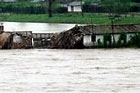
The Korean Peninsula’s central region has experienced one of the wettest rainy seasons on record this year. Many areas of the region, which encompasses Seoul, Gyeonggi and Gangwon Province in South Korea and North and South Hwanghae Province and Gangwon Province in North Korea, have been hit by more than 700mm of rain.
Some of the most severe rain has fallen in the last 36 hours, a period during which more than 20 people have lost their lives in Seoul and South Korean Gangwon Province, including thirteen in the collapse of a holiday villa in the city of Chuncheon following a mudslide. In North Korea, both North and South Hwanghae Province and parts of North Korean Gangwon Province had also received more than 100mm of rain in the same 36-hour period to 9AM this morning, leading to worries about harm to people and property there.
Shingye County in North Hwanghae Province and Pyonggang County in Gangwon Province were among the hardest hit, recording focused downpours of 154mm and 158mm respectively. The two counties now have one-month rainfall records of 701mm and 702mm each.
Elsewhere, Kaesong and Haeju, both major cities in southwest North Korea, were hit hard on the 27th, recording 77mm and 110mm respectively. In the case of Kaesong, this means that fully 55% of its annual average rainfall (870mm of 1576mm) has now fallen in July alone, most notably 423mm in one intense four-day period.
Reporting on the dangers posed by the rainfall, Chosun Central Broadcast, the state radio station demanded yesterday that local regions “establish comprehensive safety policies in the people’s economy, including the farming sector.”
Meanwhile, the extraordinary rainfall is likely to continue until early next week, according to the Korean Meteorological Administration, meaning that further harm is likely in both North and South.







