

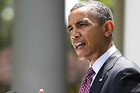
U.S. President Barack Obama yesterday moved to extend government sanctions against North Korea for a further year.
In a statement sent to Congress, he cited North Korea’s “weapons-usable fissile material” as the primary reason for the maintenance of the sanctions regime.
North Korea, he claimed, constitutes an “unusual and extraordinary threat to the national security and foreign policy of the United States constituted by the existence and risk of proliferation of weapons-usable fissile material on the Korean Peninsula.”
Existing U.S. economic sanctions against North Korea are rendered legal by the 1977 International Emergency Economic Powers Act (IEEPA), which imposes limits to commercial interactions with states considered to be the cause of a U.S. “national emergency”.
However, because they fall under the auspices of the National Emergencies Act (NEA), any sanctions imposed under the IEEPA must be renewed on an annual basis.
Three separate ‘executive orders’ regarding North Korea have been issued pursuant to the IEEPA; EO 13466 of June 26th 2008, EO 13551 of August 30th 2010, and, finally, EO 13570 of April 18th 2011. All have imposed new and increasingly broad restrictions on commercial interactions with named North Korean entities and individuals.
Other states that currently fall under the IEEPA include Belarus, Iran, Syria and Zimbabwe.







