
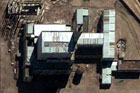
On the 14th, North Korea suspended its operations at Yongbyun nuclear facilities. This is the first time in 55 months that a switch has been turned off since North Korea’s second nuclear threat in 2002.
In an interview with the Chosun (North Korea) Central News Agency, a spokesperson from North Korea’s Foreign Affairs Ministry confirmed, “We suspended operations under the observation of inspectors from the International Atomic Energy Agency (IAEA) on the 14th, in accordance to the agreement and delivery of 50,000tons of fuel.”
The spokesperson urged, “Now, the other members of the February 13 Agreement must practice their duties according to the principal of ‘action for action.’ Moreover, it all comes down to how the U.S. and Japan will withdraw and implement their hostile policies.”
◆ Difficulties in disablement = It was revealed by the U.S. State Department spokesperson Sean McCormick, that a declaration had been received on the 14th that North Korea has shut down its nuclear reactor. However, to be specific, North Korea did not ‘disable’ their facility, rather it was ‘suspended according to a South Korean official.’
In order to disable the atom, the gateway to the nuclear reactor must be blocked after operations have been suspended. The gateway must be tied with special wires provided by the IAEA and then a number attached on top. The process whereby wires are used to tie the reactor is called the seal. After IAEA inspectors have sealed it, monitoring cameras are placed and the whole facility is dismantled.
North Korea and the IAEA made an agreement to disable 5 facilities including the ▲ 5MW atom in Yongbyun ▲ nuclear fuel reprocessing facilities ▲ factory manufacturing nuclear rods ▲ 50MW nuclear reactor in Yongbyun (constructions currently terminated) and ▲ 200MW nuclear reactor in Taechun (constructions also terminated).
Following, on the 14th, Adel Tolba, head of the IAEA’s inspection team and 10 advisors visited North Korea equipped with 15 monitoring cameras and sealed around 500 equipments and gateways of nuclear facilities. Though Mohamed ElBaradei, the Director General predicts that it would take a month to abolish the facility, government officials argue that it could be completed within 2~3 weeks.
Many experts predict that shutting-down the Yongbyun facility would not be difficult but rather speculate that the disablement process would not be easy. It seems that the members of the six party talks will need to discuss with North Korea the understanding of ”disablement.”
Members of the six party talks analyze “disablement” to literally mean, an end to using nuclear facilities. One of the ways to do this would be to either pour concrete on the reactor after breaking its surrounding wall or to extract the nuclear reactor core and the running gear of the control rod and seal the remaining area with other special objects.
Regarding the notion of disablement, North Korea’s representative to the six party talks, Foreign Minister Kim Kye Gwan said following the February 13 Agreement, “It’s like castrating a bull” suggesting that disablement meant a permanent disability. However, there were times after the February 13 Agreement, when North Korea used the term “neutralization.” Hence, there is a need to clarify the understanding of disablement, as there is a possibility that clashes may arise.
◆ Pending questions in the disablement process = There are problems that may arise following the shutting-down/sealing process, however the greatest issue at hand is reporting all the nuclear programs listed and surrendering these programs in accordance to the September 19 Joint Statement.
North Korea’s deputy chief to the U.N. Kim Myong Kil clearly stated in an interview with AP that the second phase of implementation requires Pyongyang to submit a list of its nuclear inventory, after which the U.S. must remove North Korea from its list of terror-sponsoring nations and lift the sanctions against it.
However, this coincides with the February 13 Agreement which states that “the U.S. will begin the process of removing the designation of the DPRK as a state sponsor of terrorism, and advance the process of terminating the application of the Trading with the Enemy Act with respect with the DPRK.”
Further, though the U.S. and six party talks aim to push for North Korea to report its nuclear program in conjunction to disablement, it seems that North Korea will first report the nuclear programs then conduct disablement. Every time the notion of disablement is brought up, it is sliced up into pieces, demands made acting as a “salami tactic.”
Moreover, it seems that the nuclear program report and the removal of the U.S. hostile policy will be associated with one another and further, the disablement measures linked to the negotiation of peace system on the Korean Peninsula.
In addition, there is a high possibility that the validity of reports on its HEU issue will be questioned and whether the February 13 Agreement will be able to continue its momentum. However, one cannot remove the possibility that the Bush Administration may engage in “dirty” negotiations aiming to confirm the existence of HEU programs in order to reach the virtual settlement of the North Korean nuclear issues before its final term in office.