
[imText1]In order to resolve the nuclear, human rights, and other North Korean issues, North Korea should democratize after opening and reforming first.
However, domestic diplomatic security experts hold the general opinion that a Chinese-style open and reform is impossible because of nuclear weapons development and military-first politics. If North Korea opens and reforms, it can be a threat to Kim Jong Il’s regime.
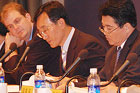
A talk called “looking at the change in North Korea’s system after the February 13 Agreement,” sponsored by nongovernmental research organization Peace Foundation, was held on the 19th. At this talk, Korean, Chinese, and Japanese diplomatic security experts forecasted that the durability of the North Korean system is currently facing an extremely dangerous situation, but it will not step forward for opening and reforming to overcome this situation.
They analyzed that “military-first politics” for controlling North Korean civilians and “nuclear development,” the crux of its foreign strategy are clash with attempt to develop North Korea’s economy. Further, they observed that the change in Kim Jong Il’s system, rather than disintegration of the system or long-term existence, is heading towards gradual collapse.
Chinese Communist Party’s Central Party School Professor Jo Ho Gil presupposed, “From the strategy of preserving national security, nuclear development and military-first politics contradict with open and reform.” He further gave the analysis that, “Defending military-first politics incurs a serious national risk from the outside, while open and reform absolutely demands preservation of national security under the Kim Jong Il’s system.”
Consequently, the Kim Jong Il regime will not abandon the reign of military-first politics in order to preserve its system.
He explained, “North Korea, in the mid-90s, selected military-first politics as a means of coping with an economic threat and as a strategy to keep its politics alive. As an international survival strategy and means domestically to suppress the people, it carried out nuclear development. At the same time, it began reform through the July 1 Economic Measures, 2002, which was modeled after the Chinese economic reformation. However, with opening not having caught up yet, dilapidated facilities and outdated technology as well as the imperative shortage of raw materials after the pursuit could not meet the demands of the market.
Then, he added, “The system itself is repeatedly going through vicious cycles due to the contradictions of North Korea’s three main strategies: military-first policy, economy policy, and nuclear development.”
Japan’s Shizuoka University Professor Izumi Hajime added, “North Korea, from the current perspective, will preserve Kim Jong Il’s dictatorship for a while and will strengthen as a whole transactions with the U.S., North-South Korea relations, and economic reconstruction. Accordingly, in a period of several years, North Korea will not face the risk of disintegration, but there is no way it will clearly walk the path of democratization either.”
Jo Sung Ryul, a chief-researcher of Institute for National Security Strategy, observed, “Policy of military restraint build-up prepared owing to military-first politics, by strengthening the power base of the army unit, incurred the result of weakening the societal system. Nonetheless, that does not mean that Kim Jong Il will abandon military politics and will head towards open and reform for strengthening the societal system.”
He added, “Through open and reform, the crisis to North Korea’s system can be overcome, but it is doubtful whether the North will abandon nuclear weapons and all nuclear programs which is the precondition for North Korea’s opening.”
A chief of defense issues task force of Korea Institute for Defense Analyses, Baek Seung Joo forecasted, with the leadership issues of North Korean leaders, the influence of the North Korean army, and the environment of enticing foreign capital as reasons, “The North Korean economy differs from the Chinese economy, so it will be difficult to reap significant results.”
Further, experts observed that as long as North Korea does not go down a path of open and reform, it will undergo the eventual process of disintegration, not radical change.
Professor Hajime said, “All of North Korean politics is based on strengthening the preservation of the ‘one-man power’ of Kim Jong Il. Within a matter of several years, North Korea will not face the crisis of ‘disintegration.'”
He added, “Even if North Korea does not give up development of nuclear weapons and ballistic missiles, if it does not enforce mid-distance ballistic missiles and nuclear experiments, the likelihood is high that the surrounding countries will basically select symbiosis with North Korea. Due to the relapse of North Korea’s nuclear experiments and mass-scale defection of North Korean civilians, North Korea will remain as the “main cause of instability” in the Northeast Asian region.”
Jo maintained, “If an epochal open and reform does not follow, since the weakening and long-term ruin of North Korea’s system is inevitable, gradual disintegration’ theory of North Korea is persuasive.”