

In this year’s New Year’s Address, Kim Jong Eun promised a year of prosperity for the North Korean economy, driven in part by improvements in the agricultural sector. By February, state efforts undertaken to solve the nation’s perennial food insecurity included a mass gathering
in Pyongyang attended by heads of farming units from around the country.
With North Korea’s farming season now in full swing, state media
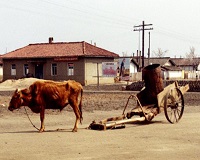
tells of workers “exceeding expectations” thanks to the use of oxen in the plowing
process. Next to the land itself, oxen have long been considered the most
important factor in the “socialist production method.” They have a historical
role, too, as a vital mode of transport during the Korean
War. Perhaps most indicative of the value of the ox is that the act of killing one is considered a political crime.
How are these animals regarded now that North Korea has adopted the principles of a market economy?
At present,
North Korea’s cooperative and state-run farms are comprised of “work units.” Each
unit of 10-12 people is generally assigned two oxen and machinery including a
tractor. Often several units are be combined into a “taskforce,” as one cooperative farm worker from North Hamkyung Province and Daily NK source
explained.
“I work in a ‘youth unit’ made up of 35 young people who were dispatched to the farm after graduating from high school. We are combined with five other
units to comprise a ‘taskforce,’ with 20 cows between us,” he explained.
“On principle, the management
of the oxen is supposed to be a group effort but now one person from each unit
is elected to this position because there are real fears of thievery. Many people lost their lives stealing
cows during the period of economic hardship during the 1990s. When an ox went missing,
not only would the unit heads and task-force leaders be questioned, but also the
cadres who oversaw operations at the farm.”
Nowadays, each taskforce nominates four people to build pens and source feed.
“The managers of the oxen prefer to build pens in their own
backyard and manage them that way. They really fulfill two objectives; to ensure
the ox stays alive and that is doesn’t ‘disappear.’ In practical terms they must find enough for it to eat and make
sure it stays healthy,” the source went on.
Like other members of the cooperative, their efforts are assessed on a points system that is calculated at the end of each working year. Payment is then distributed accordingly. For the manager to receive 100 points, he must source 20kg
of corn for every ox under his charge. As a point of comparison,
general farm laborers can earn up to 600 points for a 100% attendance rate over
a whole year. The stakes are higher for the ox handlers, however, because if one dies or is stolen then points are deducted, on top of other, harsher “political” punishments.
According to the source, all North Korean oxen have a unique
number “equivalent to a name.” This number is either etched into the oxen’s horns
or written on a tag and pierced through its ear.
The animals are so important to the running of the nation’s
farms that when thievery and smuggling became prevalent in the border
regions near the Tumen River in the mid-2000s, the regime reportedly demanded that the Chinese authorities send back any oxen found bearing a distinctively North
Korean number.
For the managers of the oxen, sourcing feed is often the most
stressful aspect of the job, the source asserted.
“Up until the 1980s there was an annual distribution of 70kg
of feed per ox, but that had ceased by the 1990s. Desperate countermeasures were soon adopted.
In summer, ox were fed grass sourced from the mountains and fields, and in
winter, corn stalks and bean pods farmed at the unit were used as feed. This
was not a small task, as normally one cow requires around 5kg of corn per meal.”
Moreover, “An order came down from the Party Secretary of the cooperative farm that all in the unit had to work hard
to procure salt and feed for the cows during the busy farming season. This task
was seen as an act of loyalty, and many had no other option but to wash cereals
in their home and present the water runoff.
At its worst, people used to give their urine as a salt substitute
for the oxen; this was the reality of North Korea in the 1990s.”
To be continued…









