

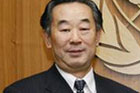
North Korea used its speech to the UN General Assembly yesterday to assert that there can be no denuclearization for as long as the U.S. continues to threaten its security.
Delivering the speech, Vice Foreign Minister and UN Permanent Representative Pak Kil Yon declared, “As long as the U.S. nuclear aircraft carriers sail around the seas of our country, our nuclear deterrent can never be abandoned, but should be strengthened further. This is the lesson we have drawn.”
“The tough-and-go situation created some time ago in Northeast Asia, including the Korean Peninsula, undoubtedly proved once again that the United States is not a defender, but a disruptor of peace,” he added.
The U.S. has recently been engaged in a number of military exercises with the South Korean military in both the East and West Seas as part of its response to North Korea’s sinking of the Cheonan. North Korea reacted particularly angrily to the involvement of the USS George Washington, a nuclear powered aircraft carrier, in exercises in the East Sea at the end of July.
“Had it not been for the powerful war deterrent built by the Songun (Military-first) Politics of the great leader of our people General Kim Jong Il,” Pak went on, “the Korean peninsula would have already been turned into a war field scores of times, thus destroying regional peace and stability.”
North Korea’s UN ambassador also moved to deny once again the conclusions reached by the independent investigation team into the Cheonan sinking, which he called a U.S. and South Korean plot.
In the written version of the speech, Pak, using lower case to deny the existence of the state of South Korea, called the sinking just the most recent example of “saber-rattling, arms buildup and threat of use of force waged on a massive scale by the United States and south Korean authorities on the Korean peninsula and its surroundings.”
He also again accused South Korea of “kicking up a war atmosphere against their fellow countrymen in collusion with foreign forces with a view to rationalizing their confrontational policy against the north,” called the international investigation “unilateral” and said it has attracted “manifold criticism in and out of south Korea.”
Pak was presumably referring to experiments carried out by Professor Lee Seung Hun of the University of Virginia, who suggested in late May that extreme heat in a torpedo explosion would have burned away the words “No.1” which were written on the bulkhead disc plate of the torpedo drive shaft found at the scene of the Cheonan sinking, meaning that it could not have been responsible for the Cheonan incident.
However, Professor Lee’s claims were comprehensively refuted by Professor Song Tae Ho of KIST, a South Korean science and technology university, in August when he released a report saying, “Even in extreme cases, the temperature of the torpedo propulsion section rises by 20˚C at most, so there is no absolutely no chance of the paint or lettering suffering heat damage.”
Finally, Pak also reiterated the need for a peace treaty and North Korea’s demand for recognition as a nuclear state.
This year, Pak said, North Korea has “proposed respectfully to the parties to the Armistice Agreement to begin talks as early as possible for replacing the Armistice Agreement with a peace agreement.”
This, he asserted, “will represent the most effective confidence building measure for removing distrusts among the parties to the Armistice and serve as a powerful driving force guaranteeing the denuclearization of the Korean peninsula.”
However, most experts agree that in reality North Korea’s regular peace treaty demands are just a part of its wider policy of so-called “salami tactics”, by which it divides the activities associated with denuclearization into small slices in order to avoid ever reaching the point of irreversible denuclearization.







