

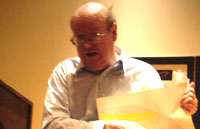
[imText1]Prof. David Garretson, a former U.S. diplomat and now a professor with the University of Maryland University College’s East Asia division, presented a lecture at Osan Air Force base here in the Republic of Korea on Friday. His lecture titled, “North Korea and the U.S. at a Crossroads,” enthralled the audience of military officers and professional civilians. Garretson used his experience as a diplomat and as an expert on South and North Korean history and culture, to interpret North Korea’s recent actions and what they mean for U.S. foreign relations.
U.S. Balances Regional Powers
Highlighting the importance of geopolitics around the Korean Peninsula, Garretson pointed out that the Peninsula has long-been the center of conflict in East Asia, partly because of its geographic location between the “four great powers present in East Asia:” Russia, China, Japan, and the U.S. He said, “These four great powers carried out a lot of their fighting in Korea. These interactions go on today.”
Because of this, “North Korea is looking at the U.S. as one of the major global powers that it can get a good deal with, which would create leverage,” and this agreement would keep the other great powers out of the Korean peninsula. To explain why North Korea would look at the talks this way, he pointed out that, “Americans tend to forget how other societies look at current events through the prisms of their history.” He elaborated that Kim Jong Il may intend to draw on North Korea’s previous experiences with the U.S. in 1994 as a guide to what to expect from the current Six-Party talks. Moreover, he stated that North Korea might be thinking that, “if they could get a settlement of some kind, they could use that agreement as a balance with the other great powers.”
North Korea Wanted Attention
Garretson contended that because North Korea’s nuclear test involved a low-yield device, below 1,000 tons of TNT, which was possibly used with crude technology, North Korea’s main goal might have been to simply get the attention of the U.S. However, he pointed out that while North Korea might get the attention of the international community, the test might also encourage South Korea, Japan, and Taiwan to pursue nuclear weapons.
Garretson pointed out that the North Korean government might have thought, “[we] could receive something for earning the attention of the U.S.” Garretson contended that North Korea might think this way because the U.S. “basically stopped South Korea from making her own bomb in the 1970’s,” which also earned the attention of the U.S. Because of this, he said, it is possible that since North Korea saw that the U.S. intervened on South Korea’s nuclear ambitions, North Korea might have learned that if it too were to pursue a bomb, they could receive the same kind of attention.
Regional Arms Race
Garretson pointed out that it would not be much of a challenge for South Korea, Taiwan, and Japan to build nuclear bombs in a short time period. He stated that “40% of South Korea’s power comes from about nine nuclear reactors,” and South Korea could make a bomb in a short time. He contended that Japan also is in a position to make a bomb in a very short time period. In fact, he stated that some reports found that, “Japan could develop a bomb in six months.” Moreover, Garretson pointed out that, “The IAEA agreements do not say what Japan can do with its supply of plutonium.” He also noted that Taiwan has a lot of nuclear power plants and might want to develop nuclear weapons in response to North Korea’s nuclear testing, but that this will create problems with China. Garretson elaborated that because the U.S. is seeking China’s help to pressure North Korea to disarm, China may ask the U.S. to encourage Taiwan to return to control under China.
Mistakes in Understanding North Korea.
In explaining his view on how to interpret the mistakes that allowed the international community to overlook North Korea’s resilience, which led to their nuclear proliferation, Garretson stated that, “One of the biggest mistakes in my opinion [with North Korea], is that “because communism collapsed in Eastern Europe… and communism collapsed in the Soviet Union, [we think that] it will happen in North Korea. One of the key factors with the Communist Regime in the North… is they are very Korean. Kim Il Sung-ism is taking Marxist-Leninism and making it into a Korean version of Marxism, and its heavily rooted in Korean nationalism and identity. And so even though Kim Jong Il has his people starving … there is that strong bond of communism, and Kim Il Sung-ism is not going to go away easily.”
Garretson pointed out that if North Korea gives up its nuclear weapons, it would be the second ever nation to give up its nuclear arms. He noted that, “The only country that we know of that voluntarily gave up nuclear weapons was South Africa,” which gave up “eight or nine devices.”
Six-Party Talks
Interpreting the current Six-Party talks and what is to come of them, Garretson pointed out that news organizations have leaked information hinting that North Korea may be provided 500,000 tons of oil to be used as energy as a result of the Six-Party talks, which is similar to the framework agreement President Jimmy Carter negotiated with Kim Il Sung. However, Garretson said, “I read it [the oil agreement] that North Korea wants to go back to where it was in 1994… they [North Koreans] want to cut a deal on the first step [referring to the 1994 deal]…they [North Koreans] are very conscious of history.” Garretson also noted that because the U.S. is meeting North Korean officials behind closed doors and in unofficial meetings, it is very likely they are close to an agreement. They [North Korea] know they got that deal out of… the U.S. government.” Using North Korea’s desire to return to the same 1994 deal as an example, Garretson pointed out that North Koreans are a lot more predictable than we admit.









