
The Rodong Sinmun recently reported that a move-in celebration was held for hundreds of newly built houses in a village along the Jangja River.
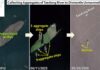
Recent satellite images reveal that a new village has been constructed along the Jangja River in Songgan county, Jagang province, replacing a community and farmland that were destroyed during severe flooding of the Yalu River last summer. The images show new houses rising to replace old, dilapidated structures.

Following the flood, the North Korean government organized a major recovery effort around Sinuiju. However, more than a year later, reconstruction appears still incomplete in villages throughout Jagang province, a key military stronghold for the regime.
Reconstruction efforts show mixed progress
Approximately 200 homes were swept away from Hapanmak in Songgan county during last summer’s flooding, with about 40 new buildings constructed in their place this year.
The former neighborhood is now a stretch of sand and dirt, with no traces of the houses that once stood there.
West of the village, the Jangja River flows north toward the Yalu River. During last summer’s torrential rains, the river overflowed its banks and engulfed the entire village. Surrounding farmland was also damaged in the flood.

The Manpo railroad line—connecting Manpo in Jagang province with Sunchon in South Pyongan province—runs between the river and village.
The Rodong Sinmun reported on Sept. 6 that a move-in celebration was held after several hundred homes were completed in Sinchong village, Songgan county, Jagang province. Satellite imagery shows 35 buildings with blue and burgundy roofs. In neighboring Tongsan district, 38 new buildings line the railroad tracks. Empty lots under construction suggest more buildings are planned.
Recovery varies by regional importance
North Korea’s reconstruction of flood-damaged areas appears to have varied based on their importance to the leadership and relative prosperity.
The three provinces along the Yalu River—North Pyongan, Jagang, and Ryanggang—all sustained serious flood damage. However, recovery work proceeded fastest around Sinuiju, considered one of North Korea’s three wealthiest cities after Pyongyang. The government is also implementing long-term flood prevention measures there, including constructing dikes.
Over the past year, reconstruction work has finally reached Jagang province, evidenced by the construction and move-in celebrations. However, satellite images show that Kimhyongjik county in Ryanggang province remains neglected, suggesting apparent government indifference.
Jagang and Ryanggang provinces rank among Korea’s poorest regions, partly due to barren soil. Jagang is particularly inaccessible and sometimes described as “a North Korea inside North Korea.” The province has earned the nickname jagal (meaning “gravel”) due to its poor soil quality and was reportedly devastated during the “Arduous March”—the severe famine that swept North Korea in the mid- to late 1990s.
Despite its poverty, Jagang province’s proximity to China offers national security advantages that have motivated the regime to position much of its defense industry there. The province houses many workers from North Korea’s arms factories and produces approximately 90% of the country’s military supplies.
Despite its status as a military stronghold, Jagang province received lower reconstruction priority after the Yalu River flooding than the Sinuiju area of North Pyongan province. Nevertheless, North Korean leadership has apparently not forgotten the province and is belatedly moving forward with village rebuilding efforts.