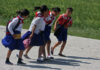


The number of child beggars in the North Korean border city of Hoeryong is surging, with homeless youngsters increasingly visible near train stations and marketplaces.
“Kotjebi typically loiter around the marketplaces in the daytime and around the train stations at night. Most are teenagers, but some are even younger. The vast majority of the beggars are boys, at a ratio of eight boys to two girls,” a source in the province told Daily NK recently, using a term referring to homeless children.
“Young beggars have increased in number since last year, with citizens complaining that they’ve become a disturbingly common sight,” the source added.
According to the source, the inadequate supply of food is the biggest cause of the increasing number of young beggars. Many families have collapsed with parents unable to support their children, who are now apparently roaming the streets in a desperate attempt to survive.
The source said that even children with parents are frequently reduced to vagrancy if their parents cannot support them.
Perfunctory crackdowns fail to address root causes
But the municipal authorities apparently do not regard the growing number of child beggars as a serious social issue. They only organize showy roundups without doing anything to address the root problem.
“No special efforts are being made for an issue that has persisted for decades. The regime only orders vagrants cleared off the streets without offering any fresh solutions. Whenever those orders come down, the local authorities just organize another campaign to crack down on the homeless population,” the source said.
The source said there is only one shelter for homeless children in Hoeryong. At any given time, there are around 50 children housed at the shelter, which is little better than a prison.
“The food served there is disgusting, as is the hygiene level, and children are often forced to perform various chores. So whenever they have a chance, they slip away. The percentage of children who end up back on the street is close to 100%, leading people to ask what the point of housing children is if they’re just going to run off,” the source said.
The provisions and supplies needed to run the shelter are supposed to come from the local people’s committee. But in practice, neighborhood watch units are frequently forced to pick up the tab. The source noted that such practices not only stoke public resentment but also do nothing to tackle the underlying issues.
“Officials have grown complacent and generally treat the issue as intractable. That kind of apathy surely must be a warning sign about a total collapse of the social safety net,” the source said.
“Plans to increase local rations or set up collective farms are impracticable and only exacerbate corruption. What we’re seeing is a vicious cycle caused by a perfect storm of poor shelter maintenance, pro forma roundup orders from the Central Committee, incompetence from the people’s committees, the food shortage and the breakdown of the family.”