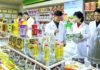


North Korean authorities changed regulations for state-run grain shops several times in the first quarter of this year, which suggests that the country has yet to establish clear rules regarding their management.
According to multiple Daily NK reporting partners last Friday, North Korean authorities issued guidelines to grain shops in each region once or twice a month, with the rules including information about grain storage methods, grain sale prices, selling dates, per-person purchasing limits and how to handle and deposit funds.
The rules were usually issued once a month, but sometimes they were issued two or more times per month. The guidelines that changed most frequently were those regarding grain sale prices and how much grain each person can buy.
Generally, the central government unilaterally selected sale prices and informed the grain shops about these prices, which led to instances where the prices were either no different than market prices or differed wildly from prices found in markets.
Daily NK has determined that grain prices at state-run grain shops are set at an optimal level based on the market prices established by three organizations: the Cabinet’s Agricultural Commission, the Economic Development Committee and State Planning Commission’s State-set Price Establishment Department.
However, not only does North Korea’s population distribution differ region-to-region, but grain supplies and how much grain shops can sell to individual customers differ as well, so determining optimal sale prices and per-person sales limits is proving difficult.
Moreover, criticism emerged inside North Korea that central government agencies should not be setting one-size-fits-all prices because agricultural production differs in the flatlands, mountain regions, and cities.
In response to this criticism, North Korean authorities recently supplemented regulations for grain shops that set price floors and ceilings while allowing provincial, city and county people’s committees and rural village management committees to adjust sale prices within those limits in accordance with local conditions.
Daily NK reported in early May that there are about 280 grain shops operating nationwide, with some also selling potatoes, soybeans, red beans and other regional specialities depending on the area.
North Korean authorities are also using the operation of the grain shops as an excuse to re-verify and update household members, residential addresses, workplaces and ration status. These reverification efforts appear aimed at preventing double sales and hoarding given that the country faces a dire shortage of food.
Grain shops use old distribution charts for grain sales
Daily NK reporting partners also said that grain shops are selling grain based on distribution charts used in the country’s past public distribution system.
That distribution system is defunct, but the grain shops are nonetheless selling grain using distribution limits based on age and gender.
These limits state that an ordinary worker can receive up to 700 grams of grain a day, while elementary school students can receive 400 grams. For example, individuals can make a single purchase this month at grain shops and buy up to 15 days of grain — for an ordinary worker, this means 10.5 kilograms of rice.
The problem facing grain shops, however, is lack of supply. As a result of insufficient stocks of food, the shops sell only five days of grain per person or limit sales to only 5 kilograms of grain per household.
Consumers are not really benefiting from the sales of grain at the shops because supply shortages make it impossible to buy that much food from them, one reporting partner told Daily NK.
Translated by David Black. Edited by Robert Lauler.
Daily NK works with a network of reporting partners who live inside North Korea and China. Their identities remain anonymous due to security concerns. More information about Daily NK’s reporting partner network and information gathering activities can be found on our FAQ page here.
Please direct any comments or questions about this article to dailynkenglish@uni-media.net.