

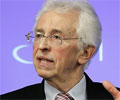
North Korea has probably not yet reached the level of nuclear sophistication required to miniaturize a bomb to mount on a missile, according to Dr. Siegfried Hecker of Stanford University. However, he believes that a third nuclear test may signal that this has been achieved, and to forestall this outcome the international community must re-engage with Pyongyang.
Dr. Hecker, a veteran visitor to North Korea’s nuclear facilities and one of three scholars chosen by Pyongyang for the purpose of publicizing its uranium enrichment facility at Yongbyon in November, 2010, explained to the 7th Sejong National Strategy Breakfast Forum in Seoul this morning, “Making a crude nuclear device small enough to mount on a missile is a very difficult job, and… in my opinion they need another nuclear test in order to miniaturize.”
He also singled out Pyongyang’s collaboration with Tehran, calling it his “greatest concern.”
An equally pressing danger is that of nuclear safety in terms of the Light Water Reactor (LWR) now under construction at Yongbyon, he added. “I don’t think they are well prepared,” he said, pointing out that North Korea has neither experience with LWR technology nor access to the lessons of past errors.
Alluding to North Korea’s frequent power outages, he also pointed out, “If the electricity goes out, bad things happen.”
Overall, Hecker, who has long been an advocate of engagement as the best way to deal with North Korea, therefore asserted that the priority has to be to “stop the situation getting any worse.”
As such, he suggested that the international community should: ▲ re-engage with North Korea; and ▲ work on confidence-building measures such as a missile and nuclear test moratorium; while also ▲ “staying the course” on denuclearization, in other words refusing to accept North Korea as a nuclear state.
However, he was also critical of the idea, prevalent in South Korea, that “we can’t trust China” in terms of pushing North Korea to denuclearize.
China does not want a nuclear North Korea, he concluded, but, “China has its own views of the world. It’s an issue of coming to common ground with China.”







