

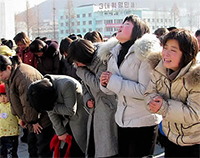
The day marking three years since the death
of former North Korean leader Kim Jong Il is now two weeks away, but Pyongyang
has yet to announce an official period of mourning, instead focusing heavily on
promotions of his songun [military first] legacy, a move that has perplexed
most residents.
“Ahead of the first year anniversary [in
2012], they announced the mourning period would be from the 1st to the 20th of
December, but this year, we haven’t heard about any
sort of grief period yet,” a source based in North
Hamkyung Province told the Daily NK on Tuesday.
The absence of any formal declaration has
many wondering if the event will pass without any sort of large-scale
proceedings. “Here [in North Korea], we think of the
three years of mourning as something of great importance,” she explained. “There haven’t been any orders, and seeing that they’re
just holding studies and lectures [on his legacy], it seems that this year,
they will mark the occasion without a grand event.”
When the country’s
founder Kim Il Sung died in 1994, Kim Jong Il declared a “three year mourning period,” and propelled
into the state’s highest position, proclaimed to be
ruling the state according to ‘Kim Il Sung’s teachings.” Upon the arrival of the third
anniversary of Kim Il Sung’s death, an edict for ten
days of mourning was issued, according to defectors in the South.
Recently, the Party-run daily Rodong Sinmun
has been following this trend, publishing stories on Kim Jong Il’s songun legacy without mention of a mourning period. In a two-page
spread, the paper ran a story on Kim Jong Eun and his onsite visit to artillery
infantry 963 to visit soldiers who have begun winter combat training. No
mention of a mourning period for the former leader appeared in the editorial.
Each year, North Korea hands down a
statement under the name of the “highest commander” on December 1st, under the title, “Duties
for Combat and Political Training in the New Year” to
all forces: military soldiers, the Worker and Peasant Red Guard, Local Reserve
Forces, the Young Red Guard, and civilian forces. Supreme Commander Kim Jong
Eun’s visit to the base on the first day of training
was his first since coming into power-a rare occurrence in the Kim Jong Il era as well.
Some have speculated the reason behind no
official decree for a mourning period to be the commencement of the training,
during which the first week is a deemed a critical period for boosting soldiers’ morale before they head into an extended stretch of political and ideological
training. During North Korea’s mourning periods, all
forms of entertainment are banned, lending weight to assumptions that the
declaration of mourning is set to come after the first week of training ends.
The source elaborated on the importance of the
initial period in setting the mindset of the troops for the long months of drills that lie ahead. “Soldiers on base march to
lively songs more so compared to other training periods, and they sing at mass
cultural events that are planned ahead,” she asserted,
adding that on the first day of training, all high-ranking officials on base
spend time with the soldiers in their infantry, while groups such as the
Ministry of Armed Forces send instructors to bases to help rally the troops.
The absence of a mourning period so far is
also likely to encourage enterprises to boost their output ahead of the year’s end, she went on to speculate. “December
is the period to ‘charge ahead at full capacity’ to make economic achievements. This is another reason why it seems
a state of mourning has not been announced,” she said.
Based on these conditions, she surmised that the mourning period for Kim Jong
Il’s third year since passing is likely to fall around
the 10th of this month.









