

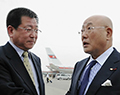
North Korea’s decision to accept a visit from a close advisor to Japanese Prime Minister Shinzo Abe may be a reflection of increasing international pressure on Pyongyang. In other words, the Kim Jong Eun regime is likely hoping to use dialogue with Japan to change the prevailing diplomatic landscape.
Chosun Central News Agency released a brief article on the Japanese arrival yesterday, reporting, “Isao Iijima, the special counselor in charge of crisis management for Japan’s Abe Cabinet, and his companion arrived in Pyongyang on the 14th.” Footage was later broadcast on North Korean television showing Mr. Iijima stepping from a scheduled Air Koryo flight and being greeted by Kim Chol Ho, a vice director in the North Korean Ministry of Foreign Affairs. Neither Seoul nor Washington was apparently informed of the visit in advance, with a Seoul official telling Yonhap that it was “surprising.”
Given the difficult international situation for North Korea at the current time, with even China making moves towards a degree of participation in sanctions against Pyongyang, the Kim Jong Eun regime is likely to have concluded that it must play the “abductee card,” wherein it offers at least the possibility of movement on the issue of Japanese abductees taken from the west coast of Japan by North Korean agents during the 1970s.
By showing a positive attitude to Japan in this way, North Korea hopes also to simultaneously undermine the foundations of trilateral cooperation on North Korea between Tokyo, Seoul and Washington, DC. Timing is important: the U.S. point man on the Six-Party Talks, Glyn Davies started a three-nation tour of the region on the 13th, visiting Seoul (May 13th-15th), Beijing (15th-16th), and Tokyo (16th-18th). U.S. Special Ambassador for North Korean Human Rights Robert King is also due to arrive in Seoul on Sunday 19th.
In this regard, the current geopolitical situation is somewhat reminiscent of September 2002, when then-Prime Minister Junichiro Koizumi visited North Korea and reached an agreement with Kim Jong Il just months after the so-called “Second Battle of Yeonpyeong” in June and not long after then-President Bush made his infamous “Axis of Evil” speech in January. Mr. Iijima also played a role in the 2002 visit, which was adjudged to have put a significant crack in the three-nation alliance.
However, it is unclear what results will come out of the latest low-key visit to Pyongyang. Prime Minister Abe did not dismiss the possibility of a visit to Pyongyang today, saying that it could be considered if it were deemed a way to solve abductee, nuclear weapon and missile issues.
Commenting on the visit today, one Seoul-based reporter for a Japanese network told Daily NK, “Counselor Iijima is the figure responsible for the abductee problem; therefore, it seems likely that they will mostly discuss the abduction of Japanese people. In the event of a certain degree of progress, North Korea could propose aid or significant restitution for past events as a condition.”
According to Bae Jeong Ho of Korea Institute for National Unification, “With even China participating in sanctions against North Korea, the only option for Kim Jong Eun is Japan and the abductees issue. They know Prime Minister Abe wants to solve the abductee problem, and North Korea has the key.”
Meanwhile, in a timely commentary released today, the publication of the Chosun Workers’ Party, Rodong Sinmun declared, “Japan’s settlement of the past crimes is not a business-like matter. It is a political and moral issue for redeeming the past crimes against humanity and an issue to be settled under international law. This serves as a touchstone distinguishing whether Japan has the will to turn over a new leaf, drawing a lesson from its crime-woven history, or not.”
It went on, “Japan, however, has evaded the settlement of its past crimes. This will result in fully revealing its moral vulgarity,” before concluding, “Japan had better opt for redeeming its past crimes with reason, though belatedly. It is a wise option for Japan.”







