

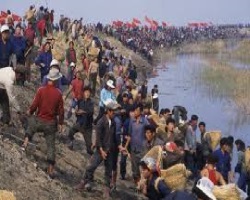
Large-scale sand mining projects that are
being carried out near Taedong River in North Korea’s South Pyongan Province
has produced a new contingent known as seonju, who
invest money to build boats for mining operations and hire day workers from
state-run enterprises, Daily NK has learned.
“Recently, a large number of the donju [new
affluent middle class] who believe sand mining is a lucrative investment have
been jumping into the market, extracting sand from the Taedong River in South
Pyongan Province,” a source based in the region told Daily NK. “We call those
donju who have entered this market seonju.”
The term seonju in Korean conventionally
refers to the owner of a ship or boat and is applied to donju investing in this industry because building a boat to utilize for digging and distribution of sand is a requirement across the board, according to the
source. Seonju purchase materials like steel plates and wood at the markets and then assemble them into vessels at state-run factories. These boats, generally equipped to transport up to three tons of sand, cost roughly 1,500-2,000 USD and are approximately 3.5 m
in length, 1.5 m in width, and 1.2 m in height.
“Seonju hire managers who can seek out new
sales routes such as state-run construction companies,” she said. “This
manager, often a family member of the seonju, plays the role of selling the sand and managing the day workers and their
payments.”
Workers who are hired to dig sand up from
the river bed and row the boats are usually young and healthy men in their 20s and 30s, paid in the equivalent of roughly 10kg of rice. It should be noted that North Koreans typically refer to the price of all goods in the context of rice prices. This is unsurprising when considering the fact that rice prices generally the determine the price of all other goods at the markets; 1kg of rice at the markets in North Korea cost approximately 5,000 KPW [0.68 USD] at the time of writing.
Those tasked with the arduous task of dragging the boat, at this point weighed down with copious amounts of sand, onto shore are remunerated for their labor with the equivalent of 2kg of rice for a day’s work, according to the source.
Laborers responsible for transporting sand on their backs from the boats to loading docks are paid based on the total quantity they cart; the same applies to workers loading the sand into trucks for distribution. These positions are filled by both men and
women, with most receiving the daily monetary equivalent of 1kg of rice. Guards overseeing the process, however, receive closer to the 10kg mark in cash.
To mitigate conflict among the seonju, the provincially-operated Taedong River Company designates numbers for each boat and allots them different sections of the river. However, fierce competition prompts many of the seonju to pay bribes to the River Company’s officials in a bid to secure favorable numbers and superior sections of the riverbed.
In addition to any kickbacks coming its way, the Taedong River Company , which falls under the
Ministry of Land and Maritime Transport, receives a 30-percent
cut of all the profits made by seonju from sand mining along the river.
“In the morning you’ll see some hundreds of boats all lined up in formation along the Taedong River,” she said. “It almost looks as if they’re going out to combat.”
Donju investing in the sand mining industry and similar projects that create work and money for the population have been coined “socialist capitalists” by residents, who wish to distinguish them from “typical capitalists,” who they view only as labor exploiters. These “socialist capitalists” projects “feed others by creating jobs–rather than feeding off of them,” the source concluded.









