

One of Kim Jong Un’s most well-known legacy projects, the Mirim Horse Riding Club, is being used exclusively by high-level party cadres and wealthy upper-class elites.
Covering some 650,000 square meters, the club was completed on Oct. 25, 2013, and features both indoor and outdoor equestrian training areas, a horse racing-centered entertainment room, a restaurant, photo studio, and gift shop.
A place for the crème de la crème
According to a reporting partner in North Korea on Tuesday, ordinary people have come to think of the club as reserved for the upper class.
People living in the provinces who want to visit the club first need to acquire special permission to visit Pyongyang along with a travel pass, in addition to paying for the general costs of their stay.
No ordinary person would be willing to waste that much time and money just to go ride horses at the club, the reporting partner said.
Nonetheless, Naenara, a North Korean publication for international readers, released an article on Apr. 16 that said “construction of Mirim Horse Riding Club was completed in October of 2013. The club was built in a wide-open area on the outskirts of Pyongyang with just the right environment and conditions for equestrian sports and education. Since then, a growing number of people have sought out the club.” The outlet went on to add that “these visitors include people of all ages, from toddlers in kindergarten to the elderly.”
Another publication for international readers, Kumsu Kangsan, ran the same coverage promoting Mirim Horse Riding Club in the magazine’s April issue.
But Daily NK’s reporting partner disagreed with these claims made by North Korean state-run media outlets.
“Every now and then, people working at provincial enterprises might be forced to purchase vouchers for group visits to Mirim Horse Riding Club or for tours of Pyongyang, but no one would ever intentionally go to Pyongyang to ride a horse,” the reporting partner said.
In fact, the equestrian club charges a great deal of money for the use of its facilities. Admission is USD 7 and one hour of horse-riding costs USD 50. The horse-riding fee alone (USD 50) amounts to a small fortune in North Korea, equivalent to KPW 420,000 or 76 kilograms of rice at the market.
“Cadres and donju in Pyongyang often buy season passes to go horse-riding or celebrate their children’s birthdays by taking their kids and their friends to the club. Ordinary people can’t do something so lavish for their kids and feel sorry about that,” the reporting partner said. In short, ordinary people feel a sense of deprivation when they compare themselves with people with money and power who can use the facility.
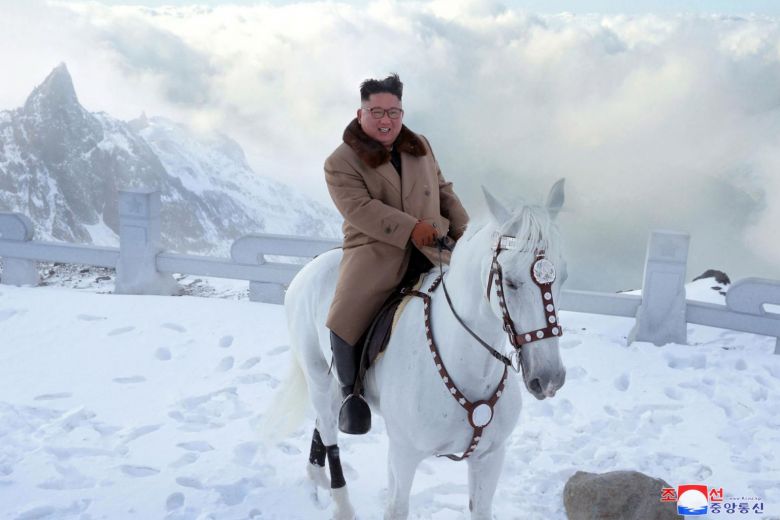
Despite the exclusionary nature of the club, North Korean propaganda continues to promote it. Some people suspect these efforts are intended to make Kim Jong Un and his family’s equestrian hobby seem like a pastime that can be enjoyed by the general public, rather than as a special privilege.
“People know that the General [Kim Jong Un] often rides horses with his children or Comrade Yo Jong [his sister],” the reporting partner said. “A fair number of people also know that the riding club was opened up to the public in order to make it look like the Kim family isn’t enjoying special privileges.”
On Feb. 8, North Korea’s KCTV broadcast coverage of the military review commemorating the 75th anniversary of the founding of the Korean People’s Army. This coverage included scenes of the Myongye Cavalry riding in formation, with the cavalry’s commanding officer riding a horse specifically identified as the “most beloved prize horse of the beloved child [Kim Ju Ae].” This comment revealed that Kim’s young daughter, Ju Ae, owns a white horse.
Will tourists return to North Korea in the near future?
On the other hand, Pyongyang cadres reportedly believe that the recent propaganda push to advertise the club is related to efforts to reopen the country to foreign tourism following the end of COVID-19 pandemic. This is because the club was built in 2013 as a means to obtain foreign currency from tourists.
Tourist areas such as the Wonsan Kalma Coastal Tourist Area and Yangdok Onchon Tourist Area have recently been given orders to restart efforts aimed at their opening, and the regime’s increasing efforts to promote the Mirim Horse Riding Club abroad might be due to efforts to open the country back up to tourists in the near future.
That being said, the regime has simply ordered for tourist sites to prepare their facilities; it does not appear that full-scale efforts to attract foreign tourists into the country have begun.
Translated by Rose Adams. Edited by Robert Lauler.
Daily NK works with a network of reporting partners who live inside North Korea and China. Their identities remain anonymous due to security concerns. More information about Daily NK’s reporting partner network and information gathering activities can be found on our FAQ page here.
Please direct any comments or questions about this article to dailynkenglish@uni-media.net.