

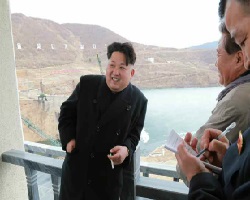
Since taking the helm of North Korea, Kim Jong Eun has
displayed consistent efforts to imitate his grandfather Kim Il Sung, the nation’s founder, in order to elicit people’s
loyalty. What do North Koreans actually make of this? An increasing number of
people are said to have given up hope for the new leadership, believing that
the young Kim seems focused on mimicking his grandfather rather than improving
their lives.
“The current society under Kim Jong Eun is
neither socialist nor capitalist; it’s a total amalgam,” a source from South Pyongan Province said in a phone call with
Daily NK on Tuesday. “Kim Jong Eun may be wearing the
clothes of Kim Il Sung on television and trying to revive the era when the
government adhered to the Public Distribution System. But how is this really effective when current living conditions are
getting no better?”
She went on to point out that residents
turn to the markets for everything they need, so attempting to drum up loyalty
from ordinary people is akin to “talking to a statue.” While the older generation may cling to lingering positive memories
of Kim Il Sung, that era is “long gone” for those middle-aged and under in North Korea, she asserted.
“People are disillusioned. They have
already seen their two ‘eternal Suns’ [Kim Il Sung and Kim Jong Il] die like ordinary people, their
bodies lying in the Kumsusan Palace of the Sun; no one sees them as deities
after that,” she explained, adding that “the more Kim Jong Eun emulates his grandfather, the more
disenchanted the population grows.”
Kim Jong Eun’s efforts to imitate his
grandfather are reflected in everything from his attire to his on-site visits to state-run
enterprises, military units, and residents’ homes. Just like the senior Kim, the young Kim has worked tirelessly to convey his purported intimacy with the public, posing for
photos with everyday people and engaging in general chitchat with soldiers. According to the source, however, these attempts may actually be having the reverse effect.
North Korean residents are coming to see
how constrained life was during Kim Il Sung’s era,
forced to be loyal to the leader despite limited state provisions and forbidden
from engaging in individual economic activities. After decades of economic
mismanagement and the end of the Cold War brought on the “Arduous March
[North Korea’s famine of the mid-1990s],” residents turned to market
activities to survive; the historical contrast highlighted by these relative economic freedoms continues to spur feelings of
discontent among the populace, who are increasingly critical of the
three-generation hereditary dictatorship and its oppressive policies.
“People do not celebrate the Day of the
Sun, Kim Il Sung’s birthday on April 15th, half as
enthusiastically as they celebrate Chuseok [the traditional harvest of the
Korean people],” she asserted. “On Seol [Lunar New Year] or Chuseok, people spend money they’ve saved up to really get into the holiday spirit, but on April 15th
people stick to the bare minimum—offering up flowers—and only those with disposable cash will drink and try to make an
enjoyable day out of it.”
Although placing flowers beneath the
statues of Kim Il Sung and Kim Jong Il–ubiquitous across the nation–on these
holidays is mandatory, some manage to avoid it altogether or participate in a diminished capacity. Purchasing these flowers is
prohibitively expensive for so many North Korean people, who struggle to make
ends meet on a daily basis, so they bum a few from friends to use instead. In
other cases, people lie and say they made flower offerings at odd hours when no
one was around, according to the source.
Even entertaining thoughts of failing to present flowers at the base of
these statues would have been unfathomable in the 1990s–let alone actually following through; however, what seems
like small shift is actually rather seismic–a clear reflection of people’s waning loyalty and satisfaction with the leadership.
*The content of this article was broadcast
to the North Korean people via Unification Media Group.









