

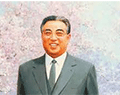
Just before the collapse of the Empire of Japan in
1945, there was only one Korean-language newspaper in Korea. This was the Maeil Shinbo, the mouthpiece of
the colonial government. After the Soviet Union occupied the northern part of
the peninsula its publication was of course abandoned as a vestige of the colonial
past.
Local leftists immediately started their
own newspapers but none survived for any significant period of time. On November 1st, 1945, the Soviet
authorities allowed the establishment of a newspaper named Chongro (lit: the
Right Way). This came to form the
mouthpiece of the Northern Bureau of the Communist Party of Korea.
Many readers
would probably know it by its modern moniker, the Rodong Shinmun. It acquired this name in September 1946 when the
Communist Party was rebranded as the Workers’ Party of Korea following the
absorption of the New People’s Party.
1945 was a year of turmoil for Korea, as
the Soviets had not drafted any specific plans for Korea before attacking
Japan. No one knew what fate awaited the
peninsula, nor who would be in charge.
The Chongro, with its structural inconsistencies, grammatical
errors and often awkward language, perfectly reflected the spirit of the times. Despite becoming increasingly
important, Kim Il Sung too was portrayed in an inconsistent manner.
In fact, in the
first issue of Chongro there was not a single mention of the future
leader. Instead, there was praise for the “leader of the Korean proletariat
Comrade Pak Hon Yong.” This was understandable since Pak was the General
Secretary of the Communist Party of Korea at the time.
Nevertheless,
my North Korean friends were quite shocked when I showed them this quote. Pak
Hon Yong was arrested and sentenced to death in the late 1950s, and his name
grew synonymous with North Korean factionalism.
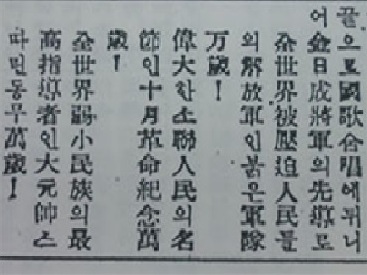 ▲ The original quote in Korean mentioning Kim Il Sung’s name. |
Kim Il
Sung’s name did not appear in the Chongro until November 7th, 1945, the anniversary of the October Revolution.
The revolution had brought the Bolsheviks to power and it was only natural that an entire issue was dedicated to this major holiday. Kim Il
Sung was mentioned in the following quote as one many participants in the demonstration hailing Stalin:
Finally, after the chorus sang a national
anthem, [everyone], led by Commander Kim Il Sung, started shouting: Long
live the liberator of all oppressed nations – the Red Army! Long live the
anniversary of the October Revolution – the holiday of the great Soviet people!
Long live Comrade Stalin – the Generalissimo, the Supreme Leader of the world’s
weak and small nations!
As the
above example illustrates, Kim Il Sung was still a long way off being presented
as the leader of the Korean people.
The turning point came on December 17th
when Kim Il Sung was appointed Chief Secretary of the Northern Bureau of the
Communist Party, elevating him to the position of leader of the North Korean
proto-state. Chongro reacted quickly, and on December 21st, an
article entitled “The Brilliant History of Comrade Kim Il Sung’s Struggle”
appeared, hailing his achievements as a partisan leader.
On January
1st, 1946, Kim Il Sung spoke to the Korean people in his first New Year’s Address.
Some argue this custom was borrowed from Stalin’s USSR, but this is only
partially true.
In the Soviet Union the
New Year’s Address was read not by Stalin but by Mikhail Kalinin, then the Chairman
of the Presidium of the Supreme Soviet and therefore the de jure head of state.
However, northern Korea did not have its own parliament so the only person in
charge was Kim Il Sung. A precedent had been set. Kim Il Sung went on to address the nation at the start of each year until his death in 1994.
There is one sentence in his first ever New Year’s
Address which is of particular interest. That is, “World War II was a great
victory for democratic nations: the USSR, the USA, China and Britain.” This may
be the only time in his public life that Kim Il Sung spoke positively of
the USA or Britain.
At that stage the
Cold War had yet to begin. and the Allies still considered themselves allies, at
least to a certain extent. In later publications this quote was changed to
read, “World War II ended in victory for the democratic camp led by the USSR.”
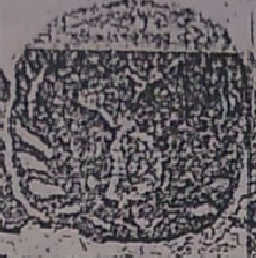 ▲ The image of a unified peninsula in the Chongro: January 1st, 1946. |
There exists another detail from this first New Year’s
Address that requires further examination. Above the Chongro article a picture
can be seen of the Korean peninsula surrounded by two ribbons. The picture’s
design is not dissimilar to the Soviet coat of arms, so one may infer there had
been hopes for a similar symbol to represent a unified Korea. Mysteriously, it
never appeared again in any subsequent publication. We may never understand its intended purpose.
On February 8th, 1946, Kim Il Sung was
appointed Chairman of the Provisional People’s Committee for northern Korea.
This structure was controlled totally by the Soviets and was viewed as a
proto-parliament for a future Communist Korean state. Thus, in a sense, Kim Il Sung had
simultaneously become both Korea’s Stalin and Korea’s Kalinin.
Kim Il Sung himself published an article in Chongro in
1946 commemorating the March First Movement. The article praised the spirit
of the participants of the independence movement in protesting Japanese colonial
rule. However, it can never be reprinted in modern North Korea for a very simple reason; North Koreans are currently taught that the entire movement was initiated by Kim Il Sung’s father, Kim Hyong
Jik. This is obviously a complete fabrication. Indeed, the article written by
Kim Il Sung made no mention of his father at all.
On April 14th of the same year, the Chongro
published Kim Il Sung’s “Twenty Points;” a guide for the construction of a new
North Korean state. In doing so he
presented himself as a leader rather than a mere apprentice of Stalin. The
Twenty Points were again included in the “Song of Commander Kim Il Sung.” The piece was composed later in the year and soon
became an integral part of North Korean ideology: “For the Twenty Points united we stand fast // Over our fair homeland
spring has come at last!”
Finally, in May 1945, Chongro mentioned Kim Il Sung
more often than Stalin. On May 17th, the slogan “Long live Chairman Kim Il Sung– the Great Leader
of the Korean Nation” came before the slogan that read, “Long live Generalissimo Stalin – the true
and benevolent friend of the Korean people!”
The order in which slogans appear has always been important in communist
countries as more important leaders are typically mentioned first. It should also be noted that Stalin was demoted from his role as “Supreme Leader of the world’s weak and small
nations” to the less lofty “friend of the Korean people.”
Nonetheless, Kim Il Sung was still far from his
eventual position as a completely independent and unchallenged leader. After all, he had yet
to replace his friend Choe Yong Gon as the Supreme Commander of the Korean
People’s Army in 1950. It would be years
before he emerged victorious after the attack on his leadership in 1956, and the
cult of personality still lay dormant.
It was in May, 1946, however, that Kim Il Sung was
first recognized as the most prominent figure in North Korean politics.








