
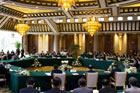
[imText1]The second level of the sixth round of Six Party Talks began in Beijing, China on 27th this month. Although the U.S. president George W. Bush called North Korea a “brutal regime” while the doubts regarding North Korea-Syria Nuclear Weapons expansion escalated, the planned Six Party Talks took place.
The issues on the sixth round of Six Party Talks will cover the nuclear disablement methods on nuclear facilities in North Korea, complete report of the list of nuclear weapons, elimination of North Korea from the list of states sponsoring terrorism, and termination of the Trading with the Enemy Act with respect with the DPRK.
The possible proliferation of nuclear programs between North Korea and Syria has stirred doubts prior to the Six Party Talks. There have also been issues being raised that perhaps this problem could influence the results of the Six Party Talks. However, to this argument, the government affiliates have stated that this will not become a hindrance.
However, the Bush Administration considers exportation of nuclear materials overseas as the “red line” act, which is why this issue is becoming increasingly important. Therefore, according to the foreign affairs experts, North Korea must give a significant and clear explanation of the Syria-North Korea’s nuclear weapons connection during the Six Party Talks.
Strategy of Disablement of Nuclear Weapons
The U.S. and North Korea has come to an agreement during the U.S.-North Korea relations’ Normalization Working Group Meeting which was held in Geneva on the 1st of September. They came to an agreement regarding the issues of disablement of North Korean nuclear by this year, and the elimination of North Korea from the list of states sponsoring terrorism.
Afterwards, U.S., China, and Russia’s disarmament experts team regarding denuclearization of North Korean nuclear came to visit the Yongbyon nuclear facilities and Pyongyang on 11th-15th to further discuss and negotiate the disablement measures of the nuclear facitlities.
It is planned that further discussions will take place with the results of the disarmament experts team’s report as the basis of their discussion. Currently, North Korea and U.S. has come to a general consensus, but there have been differences in the technical aspect.
The Assistant Secretary of State Christopher Hill of U.S. and North Korea’s foreign minister, Kim Kye Gwan met on the 27th to discuss and negotiate the methods in denuclearization of North Korea’s nuclear facilities and U.S.’ response to this act by eliminating North Korea from the list of states sponsoring terrorism.
There has been a consensus, so far, that in order to accomplish the goal of disablement by the end of this year, they will try to extract the essential parts rather than eliminating the radioactive contamination. It usually takes 4-5 months to eliminate the radioactive contamination.
In regards to the question of where they should put the eliminated essential parts, and how they should preserve the parts is causing a friction between U.S. and North Korea. U.S. wants to take it out to another country, whereas North Korea is hoping to be given the chance to preserve the parts within their country.
Declaration of Nuclear Programs without the Nuclear Weapons?
North Korean experts and government affiliates believe that this Six Party Talks should have its focus on “complete declaration of all nuclear programs” rather than putting the focus on the fact that there is a negotiation taking place regarding the issue of disablement.
Chun Yung-woo, Special Representative for Korean Peninsula Peace and Security Affairs, declared that, “Today is a very important day as we build the foundation for the Six Party Talks’ success and serve as the day to give direction for the future. It is utmost crucial that North Korea declares everything (along the process of report) of all the items that they retain.”
Whether the existing nuclear weapons will be included on the list of nuclear weapons to be reported remains an issue to be resolved. However, the participating countries of the Six Party Talks decided that in order to precede the issue of Denuclearization of North Korean nuclear weapons, the existing nuclear weapons will be left out from the list of items to be reported. This will create yet another hubbub.
The participating countries claimed that when the reporting on the plutonium is fully carried out, the number of completed nuclear weapons can be automatically figured out, thereby allowing this to be further discussed at the stage of abolition. Because North Korea is being very passive about their initial nuclear weapons, there is a limit to how strong we can push the idea of complete report of all nuclear items.
At the same time, the part that U.S. cares the most about is the UEP report in the process of report.
The general ambience is not bad considering that U.S. has stepped back from arguing about the HEU related doubts, which was the impetus for the second North Korean nuclear crisis, and North Korea has also implied that they wanted to resolve the doubts along the reporting process.
In particular, North Korea has stated on the working group meeting for Normalization of US-North Korea Relations that they have imported a 150 ton of high impact aluminum, which is used as material for centrifuge, from Russia. The 150 ton of aluminum tubes equates over 2,600 centrifuges to enrich uranium.
It is true that North Korea has admitted the importation of North Korean aluminum but they claim that their reason of importation was for “a separate reason” raising issues and curiosity on how US-North Korea will further clarify and evidence each of their arguments.
Elimination of North Korea from the list of States Sponsoring Terrorism
The U.S. and North Korea have postponed the issues of Denuclearization within the end of this year and the elimination of North Korea from the list of states sponsoring terrorism during the last Normalization Working Group Meeting. However, whether the elimination of North Korea from the state sponsoring terrorism could be achieved by the end of this year still remains a quandary.
Regarding the issue of eliminating North Korea from the list of states sponsoring terrorism, Christopher Hill, Assistant Secretary of State claimed on the 25th of this month that, “I reiterated what we have said on many occasions — which is, first of all, nothing has been done in that regard. …It is something they very much want to do. But we have made clear the issues that are important to us — that is, additional denuclearization.” (Comments to Reporters Following Dinner With Director-General Kenichiro Sasae in Tokyo, Japan, September 25, 2007, The U.S. Department of State )
In order for the elimination of North Korea from the list of states sponsoring terrorism, they must oblige to a fully report of nuclear programs as well as complete disablement of nuclear facilities by the end of this year.
However, even if North Korea were to oblige to Bush Administration, there still remains some difficult obstacles. In particular, Rep. Ileana Ros-Lehtinen (R-Florida) submitted the legislation, the “North Korean Counterterrorism and Nonproliferation Act,” co-sponsored by nine other Republicans on the 25th to the House Committee on Foreign. This could create an unexpected variable to the equation.
It is difficult to confirm whether this legislation will be passed by the U.S. Congress. But it is uncertain how the elimination of the negative perspective that exists within the U.S. Congress towards the idea of writing North Korea off from the list of states sponsoring terrorism.
Condoleezza Rice, the secretary of state told the media during an interview on 24th that she will not connect the two issues of eliminating North Korea from the list and Japanese abductees’ problem. In spite of her claims, the Japanese abductees’ issue still remains a problem in the process of eliminating North Korea from the list of state sponsoring terrorism.
In particular, it appears that the agreement negotiation will not be very easy as North Korea is asking U.S. to eliminate North Korea from the list upon their signing to the agreement of this round’s talks of North Korea disablement of the nuclear.