

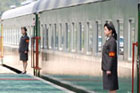
[imText1]Half a century after the Kyunghui and East Sea Rails ceased, a North-South train crossed the Military Demarcation Line on the 17th.
The continuation of the Kyunghui Line, cut off on June 12th 1951, and the East Sea Line, which was severed due to the Korean War in 1950, is taking place in 56 and 57 years, respectively.
A Kyunghui Rail train 7435 of Korea Railroad, which left the departing point, Munsan Station this morning at 11:30, passed through the MDL at 12:18 in the afternoon. The train, after receiving entry and arrival procedures at Panmun Station, arrived at 1:30 at Kaesung Station.
100 related parties of South Korea, including Lee Jae Jung, the Minister of Unification, rode the Kyunghui Line. On the North’s side, 50 people, including Ministerial Talks’ leader and the Cabinet’s Secretary-in-Charge Kwon Ho Woong, had already come down to Munsan Station and traveled with the South’s passengers. The South’s representatives
returned after having a luncheon with the North’s side at the Kaesung Janamsan Inn.
Minister Lee, as the train that he was on passed through the MDL, expressed, “Now, the dividing line is not a line of separation, but I hope it can be a line of peace, so that severed civilian relations can be newly extended.”
Kwon Ho Woong did not mention anything inside the train, but said at the luncheon, “The rail built by North and South’s cooperation is our citizen’s rail to raise a unified country through mutual cooperation of our one nation.”
Family Assembly Abducted to North Korea and related organizations came to the Munsan Station, where North and South representatives gathered to board the Kyunghui Line,
and held a protest insisting, “The pain of abductee families have not disappeared even though an exorbitant amount of material support will go towards North Korea through the rail.” However, the police did not cause a setback in the event by taking them to the station.
Simultaneously, the East Sea train left the North’s Keumkangsan Station at 11:27, passed through the MDL at 12:21 and arrived at the South’s Jejin Station at 12:34.
100 people, selected by the South’s related parties, and Lee Yong Sup, Minister of Construction and Transportation in South Korea, and on the North’s side, 50 passengers including Kim Yong Sam Minister of Railroad in North Korea for a total of 150 people were on board.
Lee Yong Sup Minister expressed at the ceremony at Keumkangsan Station before the train’s departure that “Our train, which waited a 50-years time, will once again beat its pulse while carrying the Nation’s passion towards peace and reunification and their souls.”
Lee proposed “hurrying the preparation of passage for Kyunghui and East Sea Lines by creating a “North-South Rail Joint Committee” through North-South rail experts according to the “North-South Rail Operations Basic Agreement” at the North-South Agreement in August of 2005.”
Kim Yong Sam said in his celebratory speech, “Experimental rail leaving the northern part of Keumkangsan Station will stop at the South’s Jejin Station, but in the near future, there will be reunification train that will cover the whole land of Korea.”
Further, Kim maintained that through the boarding of the rail and the pleasant conversation with Minister Lee, that “the great General (Kim Jong Il) was able to attain today’s results, in spite of preventative maneuvers by divisive powers including the U.S., by wisely leading this business and prioritizing the construction of a strong, reunified country.”
Additionally, he added, “(Kim Il Sung) leader held high interest in the rail connections from before. When preparing the `94 Summit Talk, the leader sacrificed great passion.”
On one hand, this experimental rail operation endowed the symbolic significance of extending once again the bloodline of minjok, which the train passing through the MDL historically connected for the first time in half a century.
Economically, at the time of rail passage, a reform in physical distribution can elevate North-South economic cooperation one step and in the case that Trans-Korea Railway (TKR), the Trans Siberian Railway (TSR), and Trans China Railway (TCR) become connected, the actual economic gain that North and South can attain is significant.
However, the North stopped military provisions for operating North-South trains after this “one-time” event, so a more earnest approach is needed to advance to the next level. Further, after this time’s experimental rail operations, the plan is to provide 80bn won (approx. US$86mn) of light industry raw materials to the North, so the criticism of “excessive feeding” has not been absent.
Realistically, according to the Unification Ministry, the funds invested into the rail connection construction have reached 545.4bn won. A total of 364.5bn won has been invested in the South’s section and a total of 180.8bn won has been vested in the North, including 152.3bn won in the form of a loan and 28.5bn won in incidental expenses (transportation cost and etc.).









