

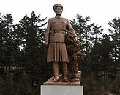
There is a growing body of evidence suggesting modest but meaningful defiance of the North Korean authorities manifesting itself in damage to monuments, according to lawmaker Yoon Sang Hyun.
Yoon, a ruling Saenuri Party (former GNP) lawmaker, made the claim this afternoon based on data obtained from South Korean intelligence authorities, asserting, “Due to the economic crisis and what-have-you, there are now more acts in rejection of Kim Jong Eun’s authority”.
The list is said to include the Monument to the Party Founding in Pyongyang (allegedly damaged last April) and a statue of Kim Jong Suk in Hoiryeong (October),.
According to Yoon’s data, there was also the discovery of graffiti around major universities and markets stating things along the lines of, ‘hereditary succession betrays socialism’ and ‘overthrow Kim Jong Eun’ in September, while Daily NK reported earlier in the same summer that anti-regime graffiti had been unearthed near Pyongyang Railroad College.
In addition, the data alleges that in February last year someone damaged Mangyungdae (Kim Il Sung’s birthplace). The rapid and public dismissal of Gen. Ju Sang Seong from his post at the head of the People’s Safety Ministry in March is alleged to have been a result of the incident, although it was reported in the North Korean media as being due to illness.
Commenting on the implied trend, Yoon said, “The tendency to treat official authority with contempt has been spreading since the time of the March of Tribulation in the 90s. In one case last year, a group of residents of Pyongyang complained to demand a solution to power shortages.”
“The people are asking, ‘What did Kim Jong Il do for us except starve us to death?’” Yoon noted, adding, “They are also expressing their dissatisfaction at the succession, saying, “Our lives have become more difficult since Kim Jong Eun became the successor’.”
There is increasing evidence of a mental break away from the regime among the young and elite, people who are more sensitive to outside information, Yoon said.
The solution, he added, is in focusing attention on popular dissatisfaction. “Looking at the bigger picture of North Korea’s problems, they depend on the people in North Korea, not on Kim Jong Eun,” he said. “Don’t just study Kim Jong Eun; the answer to the North Korea problem can only be found by embracing the anger of the 24 million North Koreans.”







