

Traditionally the most burdensome, critical dietary preparation for a Korean winter is making kimchi. Obviously, North Korea is no exception.
In northern provinces such as North Hamkyung, Yangkang, and Jagang, people bring in the radish during the middle of October and the cabbage towards the end, and kimjang (literally “kimchi-making”) season comes in early November.
In Pyongan, Hwanghae and South Hamkyung Provinces, meanwhile, they make their kimchi around half a month later than people in the more mountainous north; nevertheless, by late November all the work is usually complete.
Until the middle of the 1990s, factories and other enterprises provided staff with the radish, cabbage, red chili pepper, green onion, garlic and other ingredients needed to make kimchi after purchasing them from collective farms. Those with relatives or acquaintances in rural areas could obtain additional kimjang ingredients through personal networks.
However, now, people have to buy almost everything individually; radish, cabbage and seasonings, by themselves, with their own money.
According to a source from North Hamkyung Province, the price of the ingredients for kimchi is just as high as it was last year. Cabbage is 200 North Korean won per kilogram, radish is between 100 and 150 won, red pepper is 7,000 won, seasoning is around 3,000 won, sugar 2,000 won, and garlic around 3,000 won.
For a family of four, 400 kilogram of cabbage (approximately 80,000 North Korean won) and 200 kilogram of radish (20,000-30,000 won) are needed to get through the winter. Additionally, at least 50 heads of garlic, which comes to around 5,000 won.
Therefore, it will cost a minimum of 100,000 won to make kimchi for this winter. 100,000 won is not easy to gather, even for the relatively affluent middle classes.
Worse still, as far as the minimal remaining distribution provided by factories and enterprises is concerned, around half the weight of radish and cabbage produced by collective farms is rendered useless by the fact that people have not been able to apply enough fertilizer to the fields, while even a poor yield must first be distributed to Party apparatus, military bases, the National Security Agency, Peoples’ Safety Agency and other upper level organizations. Once we exclude this prior distribution, by the time general workers and residents receive their special, seasonal distribution, these days they can only expect to see a paltry 30 kilograms of cabbage.
This distributed cabbage or radish is just enough for the short term; kimchi salted and seasoned to see the family through the early winter. If you make an appropriate amount of kimchi, fermented and saved for the full winter, you need to buy the ingredients in the jangmadang.
Kim, who came from Shinuiju just this year, told The Daily NK, “Since 1996, I have not made any proper kimchi. I had three kids but I was not able to get any kimchi. I thought then that I would’ve been really happy if I’d been able to prepare it for my children three times a day.”
Annually, Kim used to receive 150 kilograms of emaciated, dried cabbage and 100 kilogram of radishes as small as a well-used pencil for kimchi from the factory where her husband worked.
After trimming the radish and cabbage, the ends were not thrown away, but saved for soup, not for kimchi; she dried them on her roof so that she could keep them as long as possible and then cooked them each time they were needed.
She salted the bodies of the cabbage and radish, piling them up in a big jar. Every meal, she cooked them with pepper, garlic, green onions or other seasonings, as the situation demanded. In the worse case, she just ate that salted cabbage, “white kimchi.”
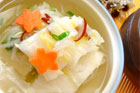
White kimchi first emerged in North Korea in around 1997. Good white kimchi, seasoned with a range of nutritious materials, is a gourmet item as well as a general side dish in South Korea. However, in the North, there is no choice but to make simple white kimchi, just salted, even for the households of high officials.
But by the middle of January, Kim’s family had generally exhausted their supplies of white kimchi. In such a poor situation, on the rare occasions that a relative visited her home with a box of kimchi, it was enough to create a festive mood for the kids.







