

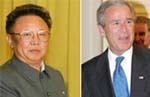
[imText1]The recent working group which opened in New York to focus on normalizing relations between the U.S. and North Korea ended in a celebration for the Feb 13 Agreement.
As promised in Berlin, North Korea agreed to the preliminary measures made at the six party talks, in which the U.S. responded by embracing North Korea’s the request, which was to remove the country from a list of countries supporting terror. At the time, both parties showed a satisfactory response.
While stopping over in Japan on his return home, the North’s representative Kim Kye Gwan said that the U.S. had promised to remove North Korea from the list of nations supporting terror. If representative Kim’s words are 100% true, then the U.S. had just re-categorized North Korea as a normal country.
The U.S.’ recent policy change on the Korean Peninsula suggests a possibility of an unknown deal made with North Korea, to incite cooperation. Yet, it is hard to accept that a gift was freely given to the enemy at the bargaining table.
There is a large possibility that Iran was the subject in the deal between the U.S. and North Korea as Iran has in the past traded actively on nuclear weapons with North Korea. It seems that the link between North Korea and Iran, on nuclear transactions was the key in prodding the U.S. to modify its policy.
As long as North Korea does not sell its nuclear weapons to third world countries or terrorists, then it is difficult for them to threaten the U.S. For this reason, will the U.S. strategically opt to be friends with North Korea who possesses nuclear weapons in order to resolve the problem in the Middle East? No doubt, the chances of this happening is rather low. Not only does the majority of the U.S. strongly distrust North Korea, the issue of the Korean Peninsula does not simply end with North Korea possessing or in this case, not possessing nuclear weapons.
Raise the South’s stakes with a new government, North’s nukes, Korea and U.S.
In the 2008 annual financial report, the U.S. Administration revealed that negotiations with North Korea would end within the year and that efforts would be made to begin dismantling nukes. In other words, before President Bush’s term was over in Jan. 2009, the issue of North Korea’s nukes would be resolved. For the next 2 years or so, the South Korean government will have to observe this pinkish “amiable” scandal between North Korea and the U.S.
On his recent visit to the U.S., North Korea’s representative Kim Kye Gwan said that nuclear weapons would not be subject to scrutiny at the negotiations. In addition, North Korea’s Vice Foreign Minister Kang Sok Ju once let slip that nuclear weapons were made to be used, not dismantled. This is the truth about North Korea and its ministers and hence its wary actions. The moment North Korea voluntarily releases its nuclear weapons, the moment it becomes an element of play and coercion of the international community.
There is a high possibility that the current negotiations will experience a grave threat in 2009. It will be an inevitable ultimatum between one side which desires to eradicate nukes and the other, desperately trying to hold onto whatever it has left.
On Jan. 30th 2009, President Bush will have to leave the White house. Though some may argue that Kim Jong Il was outwitted by President Bush, Kim Jong Il can still celebrate the fact he did diplomatically and skillfully resist Bush’s term for 8 years. In the end, it seems that North Korea’s nuclear issue will become homework for the new South Korean and U.S. Administration.
In any case, South Korea will still need to face North Korea a nuclear possessing state who will ensure that economic and political profits are gained for its leverage on the nukes and the U.S. will continue its way of extracting nuclear weapons. Yet, history has proved that North Korea’s nuclear weapons and Kim Jong Il are inseparable. In the end, Bush’s impulse may have just landed Kim Jong Il medicine.







