
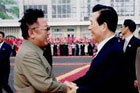
[imText1]Many are speculating whether Kim Jong Il practiced how to speak “South Korean style” for his encounter with President Roh Moo Hyun at the Summit.
Due to the difference in dialect, it is reported that Kim Jong Il only understood 80% of what the former president of South Korea Kim Dae Joong stated during the First Inter-Korea Summit.
This was revealed in a publication entitled “Waltz with Kim Jong Il” by Russian journalist Olga Malicheva who kept a watchful eye on Kim Jong Il in February and August of 2002. This book revealed the hidden stories of Kim Jong Il.
Malicheba quoted Kim Jong Il as saying, “There is a difference between North Korean dialect and South Korean dialect. I could only understand 80% of what he was saying. There are a lot of words that were coined from English,” citing what Kim Jong Il told the Konstantin Pulikovsky plenipotentiary.
In reality, the half century of separation has created inconsistencies in the Korean language spoken on the other side of the DMZ. There are words that are commonly used in the daily lives of South Koreans that are rarely found in North Korean terminology and words that are commonly used in South Korea that are expressed differently in North Korea. For example, a “pen[펜]” is called “wonjoopil[원주필]”; ice cream known as “uleum-bosungyee[얼음보숭이]”; knock known as “hand sign[손기척]”; cold juice as “cold sweet water[찬단물].” North Korean language is commonly expressed in Chinese characters or old Korean script.
There is a different concept of what is considered official standardized language used in North and South Korea. South Koreans claim that the standard language is “a modern Seoul-language that is used by educated people,” whereas North Korea claims that the standard language is “a contemporary Pyongyang language used by the working-class, referred to as ‘Cultural Language’.”
Alexander Vorontsov, a doctor in the Brookings Institute, who studied from 1979 to 1980 at Kim Il Sung University stated that, “90% of the language used in North and South Korea is roughly the same. The 10% difference comes from the language discrepancies that followed the separation. ”
Dr. Vorontsov explained that, “There was a phenomenon in which President Kim Dae Joong and Kim Jong Il had difficulty understanding each other due to the language difference.”
North Korea has had a closed policy not only in politics and economics but also in their policy regarding language. They believed that language could be used as another tool for revolution, so North Korean authorities reformed the language to best fit the Kim Il Sung Juche Ideology.
North Korea decided to polish the “Cultural Language” in 1966 by changing their Chinese words and other words of foreign origin to traditional Korean words or created newly coined phrases. The result was the invention of 50,000 or more new terms, through which a fundamental change of language took place.
The National Institute of Korean Language and the Korean Language Organization initiated research on the South Korean terms that North Korean civilians did not know. There are about 8000 of South Korean words. According to the book published by the Korean Research Institute, there are 2500 or more phrases used by North Koreans that were no longer in use by South Korea after the 1970s.
As a result, at the Inter-Korea Summit, there may be difficulties in communication due to the language gap. Therefore, President Roh is said to be making preparations in order better understand Kim Jong IL’s body language, spoken phrases, and the political terms used in North Korea.
It is also highly probable that Kim Jong Il, due to the language difficulties experienced during the 2000 Summit, may be studying South Korean terminology as well in preparation for the Inter-Korean summit with President Roh.